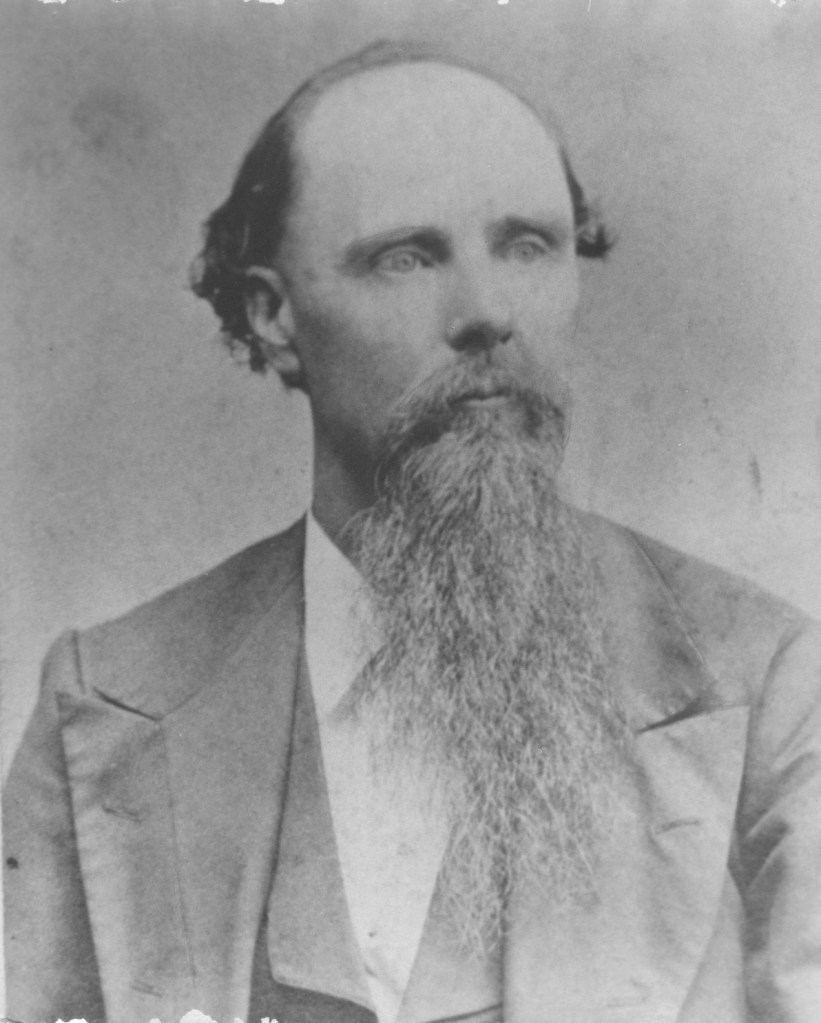
David Terrell Duncan (1833-1904)

David Terrell Duncan (1833-1904)

David Terrell Duncan was born on June 22, 1833 in Rabun County Georgia.  He was the first-born son of Daniel Duncan (age 33) and Artemisia Collins (age 23). 

According to Duncan/Cammonade family history, David’s father Daniel was a blue-eyed, red-haired, freckle-faced Scotch-Irishman who rode a pony into Rabun County Georgia from Oconee County, South Carolina.  Gold had been discovered in North Georgia mountains and by 1831 there was a rapid influx of prospectors and settlers into Rabun County.  This culminated in the Indian Removal Act of 1830 and the beginning of the 1838 Trail of Tears.  Daniel obtained 1600 acres of land from the Indians (either by trading the pony or via the land lottery).  In 1836, Daniel Duncan’s tax record shows a total of 980 acres of land.  The land was located at the foot of a large mountain which he named Duncan Mountain (now Duncan Bald).
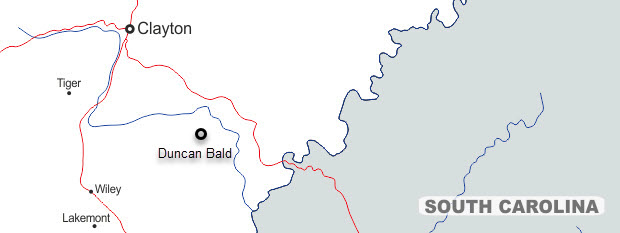
Location of Duncan Mountain (Duncan Bald) Georgia, USA in Rabun County

As Artemisia Collins was born somewhere in South Carolina, we can assume that this is where David’s parents met and married.  However, we do not have these records, nor can we be sure where Daniel and Artemisia’s family originated.

The 1840 Census for Rabun County Georgia, Militia District 436 shows that Daniel Duncan has a household consisting of 6 free white persons including himself (age 40-50, we think he was born about 1800), a son between 5-10 years old (this is David Terrell Duncan) and a son under 5 (John Duncan, born in 1835).  David’s mother, Artemisia Collins Duncan (female 30-40, she was born about 1810), a daughter between 5-10 (Jane A Duncan Connelly, born around 1830) and a daughter under 5 (Rebecca Emeline Duncan Williams, born in 1837).
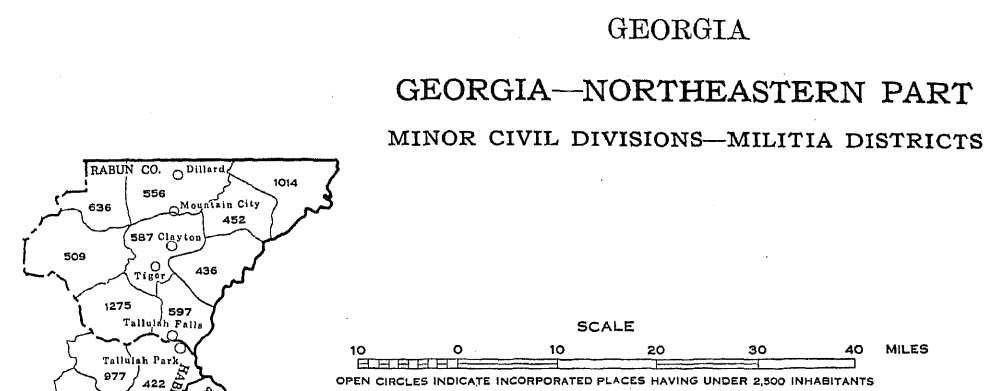
Georgia Militia Districts - Rabun County - 1840

The 1850 Census for Rabun County Georgia, Militia District 436 shows that Daniel Duncan is a farmer.  The real estate is worth about $1,000.  Daniel is 50 years old and born in South Carolina.  His wife, Artemisia is 40 and also born in South Carolina.  Jane E is 20. David is 18 and also a farmer. John is 15 and a farmer.  Emeline Rebecca is 12, William W Duncan is 9, Daniel Jefferson Duncan is 7, Dennis Dodderidge Duncan is 4 and born in South Carolina for some reason.  Deavers is only 1.  The census also states that 1 was married within the year (Jane married Charles Connelly in December 1850) and 3 attended school (probably Rebecca, William and Daniel Jr.).

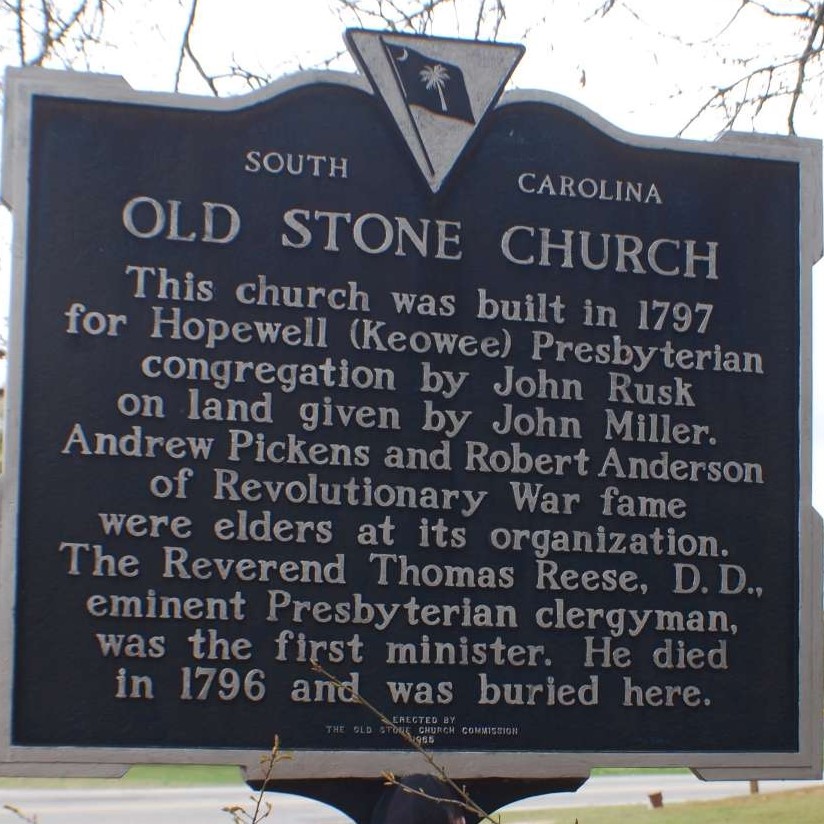
According to the 1900 Census, David Duncan married Jane Veronique Caminade in 1857.  David was 24 and Jane 17 years old.  Jane was from Pendleton, SC and Baby Mary was born at the end of November 1857 in South Carolina.  I am not able to find any marriage documents in either South Carolina or Georgia.  And we don’t know how the two met, but Williamston SC and Persimmon, GA are only about 50 miles apart.  David’s brother Dennis will marry Jane’s sister Sarah Rebecca.  Jane and Rebecca were great grand-daughters of the Printer John Miller who is buried at Old Stone Church, Clemson College, South Carolina. Miller left London, England after several of his articles landed him in jail.  Miller’s Weekly Messenger was established Jan 16, 1807 by John Miller. When Miller died, his son continued publishing the paper in 1812 when its name was changed to the Pendleton Messenger. The Messenger was published until June 1858 when it was sold to the Anderson paper.
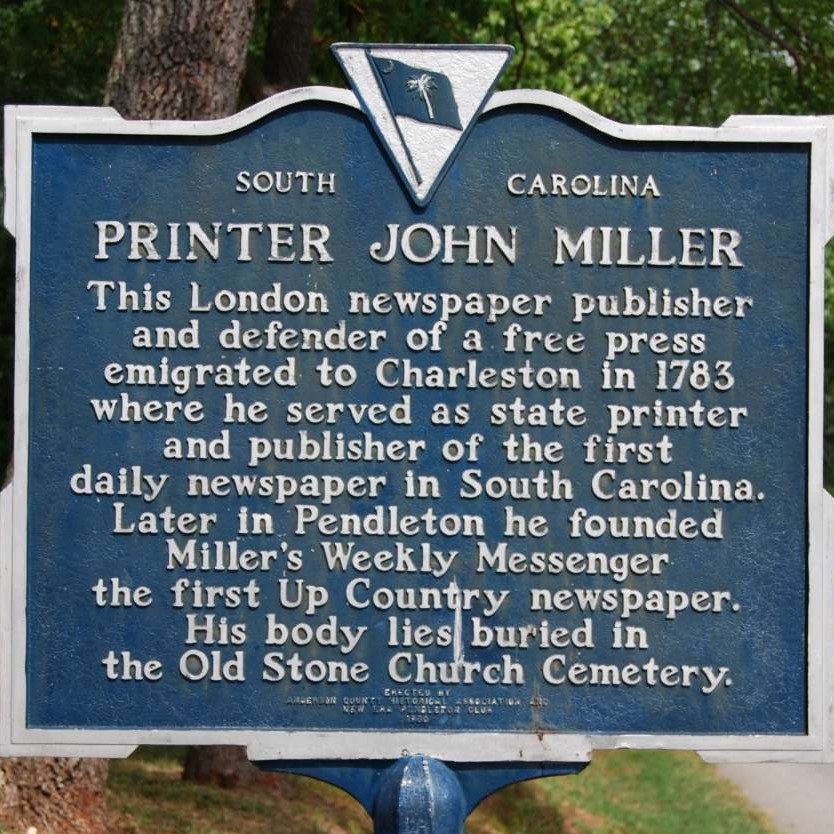
Printer John Miller Marker
Old Stone Church Marker

In the 1860 Census, David Duncan (age 27) and Jane Caminade Duncan (age 24?) have three children.  Mary Duncan Cannon is 2, Elizabeth A Duncan is 1 and baby Daniel Ira Duncan is one month old. Militia District 436 has been named Persimmon, GA.  Elizabeth and the baby were born in Georgia.  According to the U.S. Selected Federal Census Non-Population Agriculture Schedule from 1860, David T Duncan had 60 acres of improved land and 1040 of unimproved land, with a cash value of $1,500.  The value of farming instruments and machinery was $100.  Livestock included 1 horse, 1 milch cows, 1 working oxen, 3 other cattle, 23 swine, value of livestock $200.  He produced 100 bushels of Indian corn, 12 bushels of Irish potatoes, 25 bushels of sweet potatoes, value of orchard products $75, 20 pounds of butter, and the value of animals slaughtered was $45.  He would have been a rich man at the time.

1860 Rabun County Georgia census David Duncan

January 19, 1861 Georgia joins South Carolina, Florida, Mississippi and Alabama in seceding from the Union.  The state soon joined the Confederate States of America.

August 21, 1861 David’s brother William W Duncan enlists in 24th Regiment Georgia Infantry, Company E, The Rabun Gap Rifleman.  Three days later on August 24, 1861 their brother John Duncan also enlists in the same regiment.  In September the regiment is attached to Coast Defense for the Department of North Carolina.  In 1862, they are attached to Cobb’s Brigade and moved to Virginia.  Here they participated in battles from the Seven Days Battle, Battle of Malvern Hill, Battle of Harper’s Ferry, Battle of South Mountain (where 126 of the 292 men were killed) and the Battle of Sharpsburg/Antietam.  October 29, 1862 brother Daniel J Duncan enlists and joins the same Regiment.  William appears on a register for Winder Div 3 Hospital in Richmond, Virginia where he is returned to duty on Nov 28, 1862.  Interestingly enough, his brother John is detailed as a nurse at Camp Winder in Nov 1862.  After this, there are no additional records for William.  His regiment went on to participate in the Battle of Fredericksburg, Battle of Chancellorsville and the Battle of Gettysburg.    Family history says that William never returned.  In June 1863, John Duncan is listed as mustered at the Confederate Hospital in Huguenot Springs, Va. In May and June 1864, John is on furlough.  On August 16 1864, John is captured at the Battle of Guard Hill in Front Royal, VA.  By August 21, he is listed as a Prisoner of War at Old Capital Prison in Washington, DC.  On August 28, he is sent to Elmira Prison, NY.  The inmates called this prison “Hellmira”.  During the 12 months it was open, 12,100 prisoners died from a combination of malnutrition, continued exposure to harsh winter weather and disease from the poor sanitary conditions.  John Duncan died on Nov 14, 1864 of typhoid pneumonia.  The dead from Elmira Prison were buried at what is now Woodlawn National Cemetery.  Sergt. J. Duncan is in plot 813 of the Confederate section.  At the Battle of Cedar Creek (October 19, 1864), Daniel J Duncan is taken prisoner in Strasburg, VA.  He is transferred to Lookout Point, MD October 24, 1864.

D T Duncan, age 30 years and 7 months, a farmer born in Georgia is listed in the 40th Senatorial District, 436th Militia District of Rabun County.  The 1864 Census for Re-organizing the Georgia Militia was a statewide census of all white males between the ages of 16 and 60 who were not at the time in the service of the Confederate States of America. Based on a law passed by the Georgia Legislature in December 1863 to provide for the protection of women, children, and invalids living at home, it is a list of some 42,000 men–many of them exempt from service–who were able to serve in local militia companies and perform such home-front duties as might be required of them.

At this point in time, David’s brother William is missing, brother’s John and Daniel are in Virginia and both are about to be captured.  And on May 25, 1864 David Terrell Duncan enlisted in Company F, 30th Battalion Georgia Cavalry from Clayton, GA as a Sergeant for the duration of the war.  They were called the Rabun Gap Defender’s.  D T Duncan is listed as 30 years old, 5’ 10” tall, dark hair, blue eyes with a fair complexion.  He was issued his Confederate uniform on September 30, 1864.  This company subsequently became Company F, 11th Regiment Georgia Cavalry.
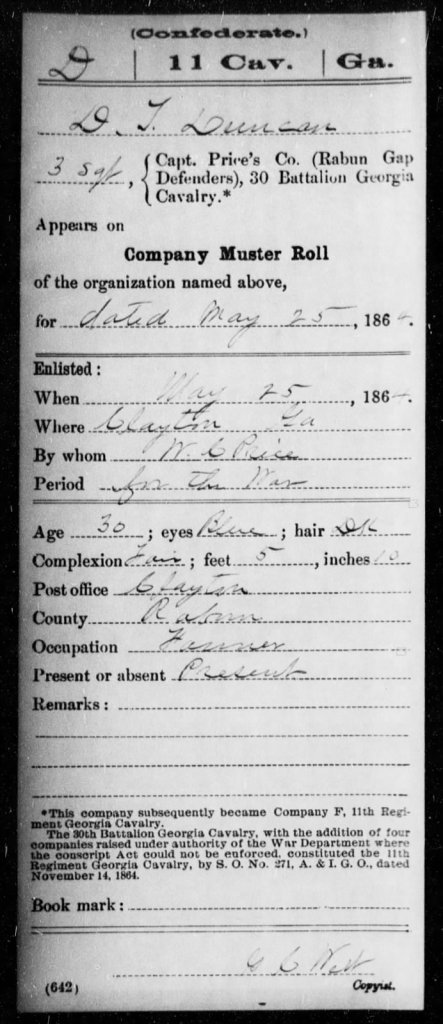
David Terrell Duncan Muster Roll Civil War 1864
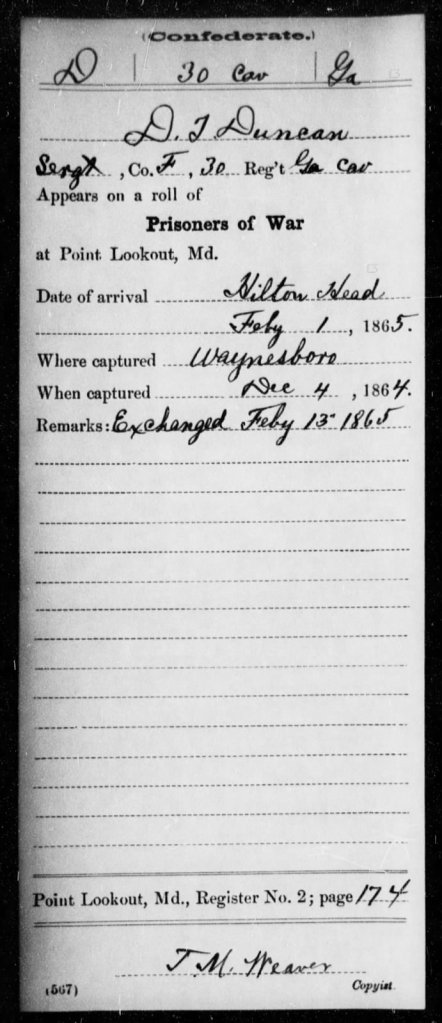
David Terrell Duncan POW Civil War 1865

11th Cavalry Regiment, in November 1864 was assigned to the Department of South Carolina, Georgia, and Florida, and served in M.W. Hannon’s and R.H. Anderson’s Brigade. It fought at Savannah, but many of the men were captured. In February, 1865, only 90 effectives were present and in April most of these were captured at Macon. Colonel Andrew Young, Lieutenant Colonel H.W. Barclay, and Major Madison Bell were its commanders.

On December 4, 1864 D. T. Duncan was captured at The Battle of Waynesboro in eastern Georgia, towards the end of Sherman’s March to the Sea.  He was captured by the 3rd Cavalry Division and turned over to the Provost Marshal in Savannah
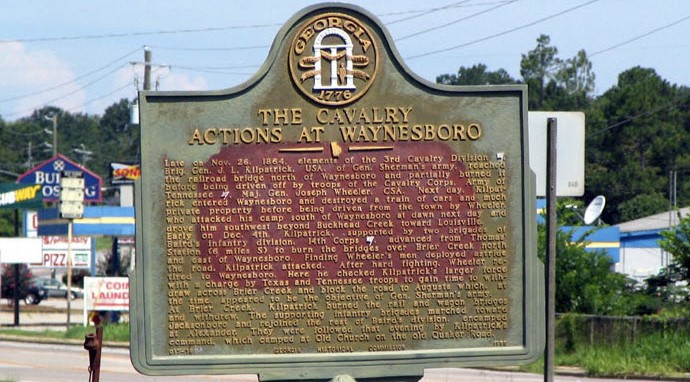
The Cavalry Actions at Waynesboro historical marker

At the Battle of Waynesboro, Union cavalry forces under Brig. Gen. Judson Kilpatrick defeated Confederate cavalry led by Maj. Gen. Joseph Wheeler, opening the way for William T. Sherman’s armies to approach their objective, Savannah.

As Sherman’s infantry marched southeast through Georgia, his cavalry under Judson Kilpatrick rode northeastward. In the late afternoon of November 26, 1864, elements of Kilpatrick’s 3rd Cavalry Division had reached the wooden railroad bridge north of Waynesboro, Georgia, and partially burned it before being driven off by troops dispatched from the Cavalry Corps of the Army of Tennessee by Joseph Wheeler. After the numerically inferior Confederates withdrew, Kilpatrick entered Waynesboro the next day and destroyed a train of cars and much private property before being driven from the town by Wheeler. At dawn on November 28, Wheeler suddenly attacked Kilpatrick’s camp south of Waynesboro and drove him southwest beyond Buckhead Creek toward Louisville.

Annoyed by Wheeler’s constant harassment, Kilpatrick set out on the morning of December 4 with his full division to attack Waynesboro and finally destroy Wheeler’s small command. Early in the morning, Kilpatrick, now supported by two infantry brigades dispatched from Baird’s division of the XIV Corps, advanced from Thomas’s Station six miles northward to burn the bridges over Brier Creek north and east of Waynesboro.

Finding Wheeler’s Confederates deployed astride the road, Kilpatrick attacked, driving the Confederate skirmishers in front of them. The Union force then came up against a strong defensive line of barricades, which they eventually overran. As the Union advance continued, they encountered even more barricades that required additional time to overcome. After hard fighting, Wheeler’s outnumbered force retired into Waynesboro and another line of barricades hastily erected in the town’s streets. There, Wheeler ordered a charge by Texas and Tennessee troops in order to gain time to withdraw across Brier Creek and block the road to Augusta, which, at the time, appeared to be the objective of General Sherman’s army. After furious fighting, the Union troops broke through and Wheeler’s force hastily withdrew.

Finally reaching his objective of Brier Creek, Kilpatrick burned the rail and wagon bridges and withdrew. The supporting infantry brigades marched toward Jacksonboro and rejoined the rest of Baird’s division, encamped at Alexander. They were followed that evening by Kilpatrick’s command, which camped at Old Church on the old Quaker Road. Additional fighting over the next few days enabled Sherman to close in on Savannah.  Sherman’s armies captured the port of Savannah on December 21, 1864.

David Terrell Duncan and his brother Daniel J Duncan were held as prisoners of war at Point Lookout, Maryland.  They were paroled from Point Lookout and appeared on a muster role at Camp Lee near Richmond, VA in 1865 (probably January).
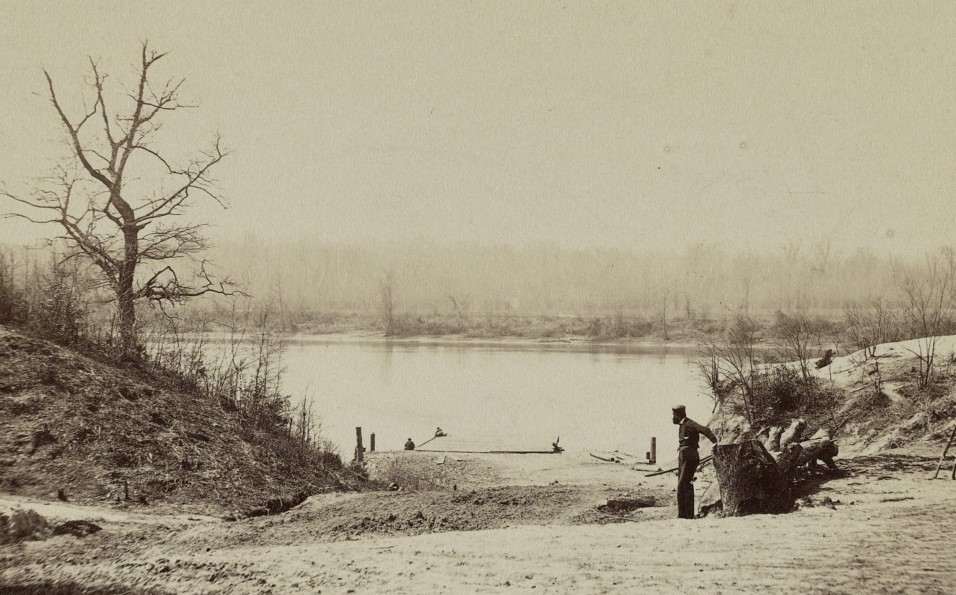
1865 Cox's Wharf

The returning Confederate POWs were offloaded at Cox’s Wharf (Landing) and walked, or were hauled by wagon, via local roads through the Union lines to Boulware’s Wharf on the James River between the lines. The distance was described as being about 4 miles. Here they were placed aboard Confederate river steamers and taken up to Richmond. Those not obviously able bodied were examined at the Receiving and Wayside Hospital (General Hospital No. 9) in Richmond to determine if they needed further medical care and attention. Those deemed to be able bodied were sent to Camp Lee on the western outskirts of Richmond to receiving fresh clothing and await their declaration of exchange. Declared exchanged, they were returned to duty with their units in the field. Those men needing further medical attention were sent to military hospitals in the Richmond area. Those unfit for duty but able to travel were furloughed home in the status of paroled prisoners of war.
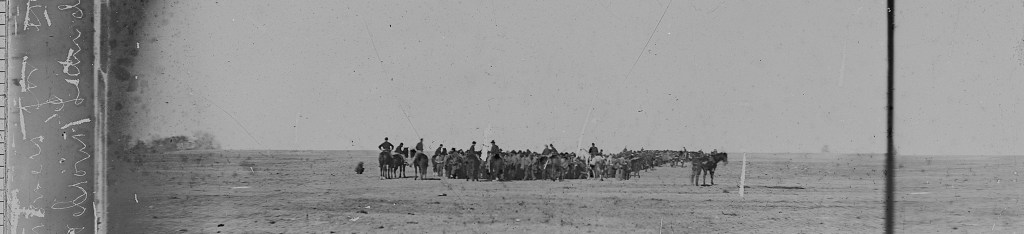
Coxes Landing, James River VA prisoner exchange 1864

The exchange process was actually a three-step process. The prisoner selected for exchange was first “paroled for exchange” meaning that he personally promised not to take up arms until properly exchanged. A parole is a sworn personal promise. The second step was “delivery” meaning that the prisoner was handed over to his own side as a “paroled prisoner of war”. The third step was supposed to be a formal (proper) declaration of exchange resulting from an official accounting process between the two sides. This accounting process got rather sloppy in the last year of the war. The Confederates continued to play the game and only declared exchanged those who could immediately return to duty and rejoin their units. The Union continued to ignore this nicety which was a holdover from the Dix-Hill Cartel. The Federals presumed that all released Confederate prisoners were forced back into the ranks, hence the adaptation of the “likely to be unfit for 60 days” selection rule.

David T Duncan arrived at Hilton Head, SC on Feb 1, 1865.  Both David and his brother Daniel were part of 2,051 Confederate prisoners transferred for exchange on Feb 13, 1865.  It is not known how or exactly when they returned to Rabun County.

Baby Ella is born in March 1865.  While the Civil War lasted for 4 years, Jane and David were separated for less than a year.

On April 9, 1865 General Robert E. Lee surrendered his Confederate troops to the Union’s Ulysses S Grant at Appomattox Court House, Virginia, marking the beginning of the end of the American Civil War.

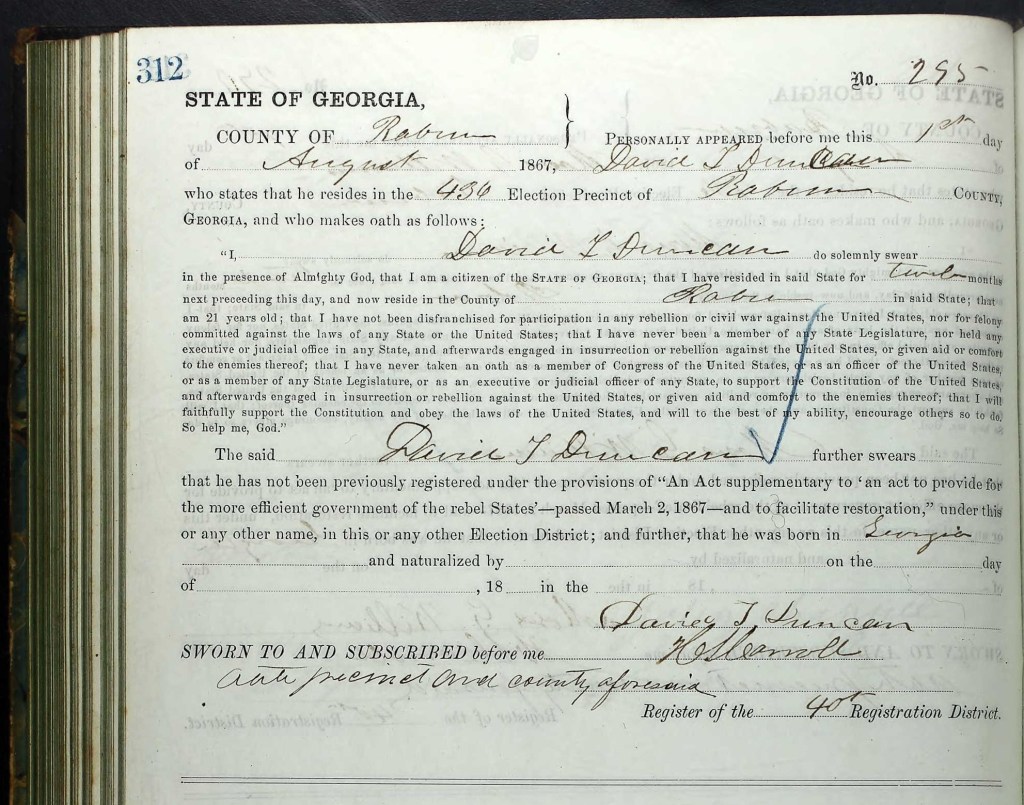
The Reconstruction Acts of 1867 required Southern states to ratify the 14th Amendment, draft new state constitutions, and register voters, both black and white. In order to vote, men had to swear an oath of allegiance to the United States, and some were disqualified for their participation in Confederate government posts.  On August 1st, 1867 David T Duncan took the oath of allegiance to the United States.  He is entered in the Georgia, U.S., The Returns of Qualified Voters and Reconstruction Oath Books in book 2 page 312, precinct no 436, Rabun County for the 40th election district.
The 1870 Census (taken on August 10, 1870) shows that David (now 37) and Jane (now 36), Mary is 12, Elizabeth is 11, Daniel is not listed and presumed that he died as a child.  However, there are 5 additional children, all born in Georgia.  Rebecca is 8, Ella is 5, William H is 3, Eliza Jane is 2 and baby Susan H is 1.  David is a farmer with $300 in personal property.  David’s mother Artemisia lives next door with 2 of David’s brothers: Jefferson and Devers.  Also living with Artemisia is her granddaughter, Susan.  The land value of the real estate in Artemisia’s name is $1,000 (apparently, most of the Duncan land was transferred to Artemisia during the Civil War).  David’s brother Dennis and his family live on the other side of Artemisia.  All are listed as farmers or farm laborer.

From 1873-1874 David is the representative of Rabun County to the General Assembly of Georgia.  This is also known as the Georgia State Legislature, the House of Representatives met in Atlanta.

1873-1874 David T Duncan is the Georgia State Representative for Rabin County

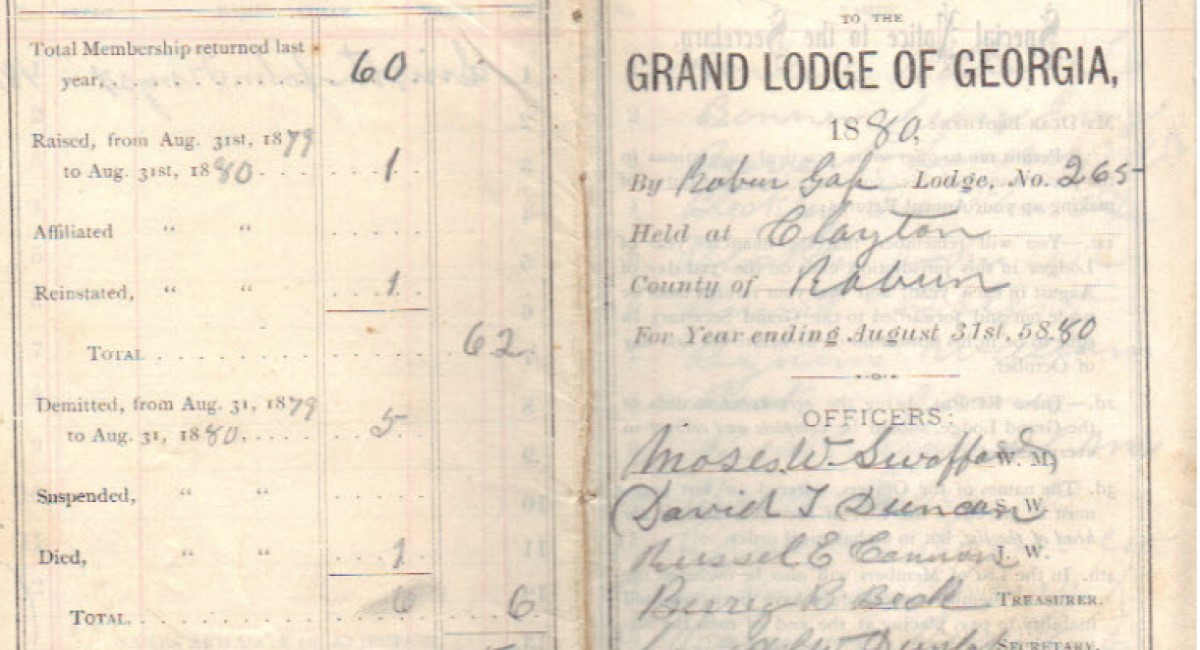
David is also a member of the Rabun Gap Masonic Lodge No. 265 and in 1880 he is listed as the Senior Warden of the Lodge.
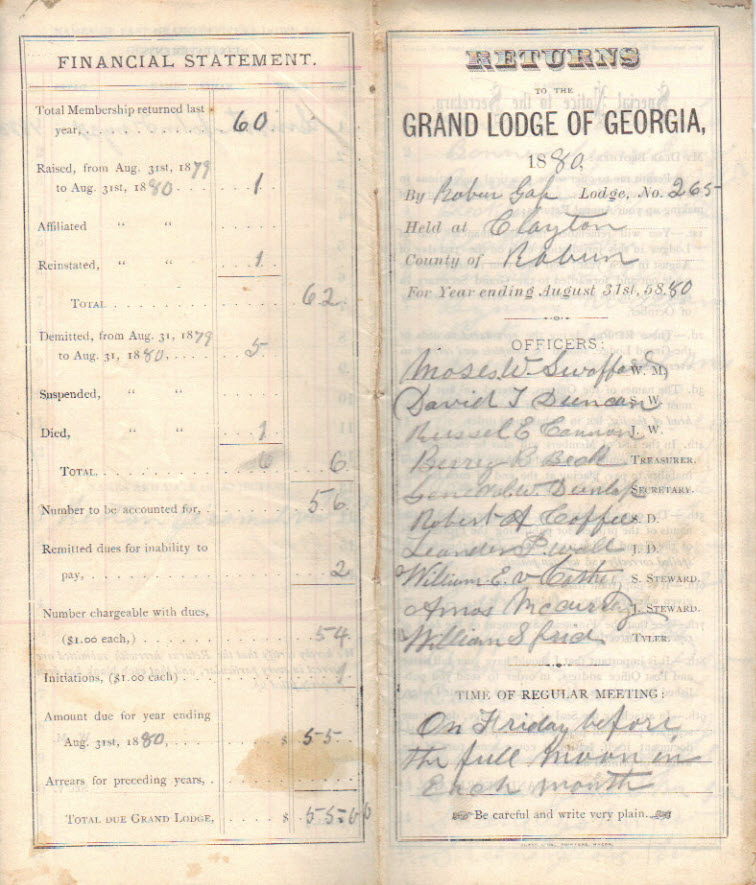
1880 Rabun Gap Masonic Lodge No. 265 financial statement

At the time of the 1880 Census, David’s occupation changes to hotel keeper (he is now 46).  Living in his household are Jane V (age 45), Mary (age 22) is now a teacher, Lizzie A (Elizabeth is 21), Rebecca A (age 17), Ellen (Ella is 16), William H (age 14), Liza (Eliza Jane is 13), Henrietta (Susan H is 10).  There are also three more daughters: Florence K (age 8), Ida (age 5) and Effie (age 4).  Daniel J. Duncan (30), David’s brother and Raleigh Cannon (22), are also living in the house.

David and Jane’s last child, Haralson Earl Duncan, is born on August 8, 1881.  David is 48 and Jane is 46.  They had 12 children, in total, over 23 years.

Raleigh Cannon (Hiram R. Cannon) will marry David and Jane’s oldest daughter Mary in 1882.  Raleigh will go on to own and run a string of successful hotels in Georgia and South Carolina.  This includes several hotels of lesser significance, the Cecil Hotel on the corner of Luckie and Cone in Atlanta (currently a Holiday Inn Express & Suites), The Hotel Georgian in Athens (now The Georgian condos and event space), The John C. Calhoun Hotel in Anderson, South Carolina (The Calhoun is now loft apartments) and The Henry Grady Hotel in Atlanta, which was located where the Westin Peachtree Plaza is now located.

In the meantime, David, Daniel and Raleigh are managing the Blue Ridge Hotel in Clayton.  The hotel was located on Clayton’s North Main Street.  It was originally built by A.M. Mauldin and his brother-in-law William Crane between 1858 and 1862 as a log trading post.  David’s family operates the establishment until selling out to his daughter and son-in-law Raleigh and Mary Cannon in about 1890? Raleigh sells the hotel to his cousin J.H. Cannon and his wife Celia in 1916.  The hotel was torn down in 1949.

Blue Ridge Hotel Clayton, GA 1895

David Duncan becomes the Grand Master of the Rabun Gap Masonic Lodge No. 265 for both 1882 and 1883.
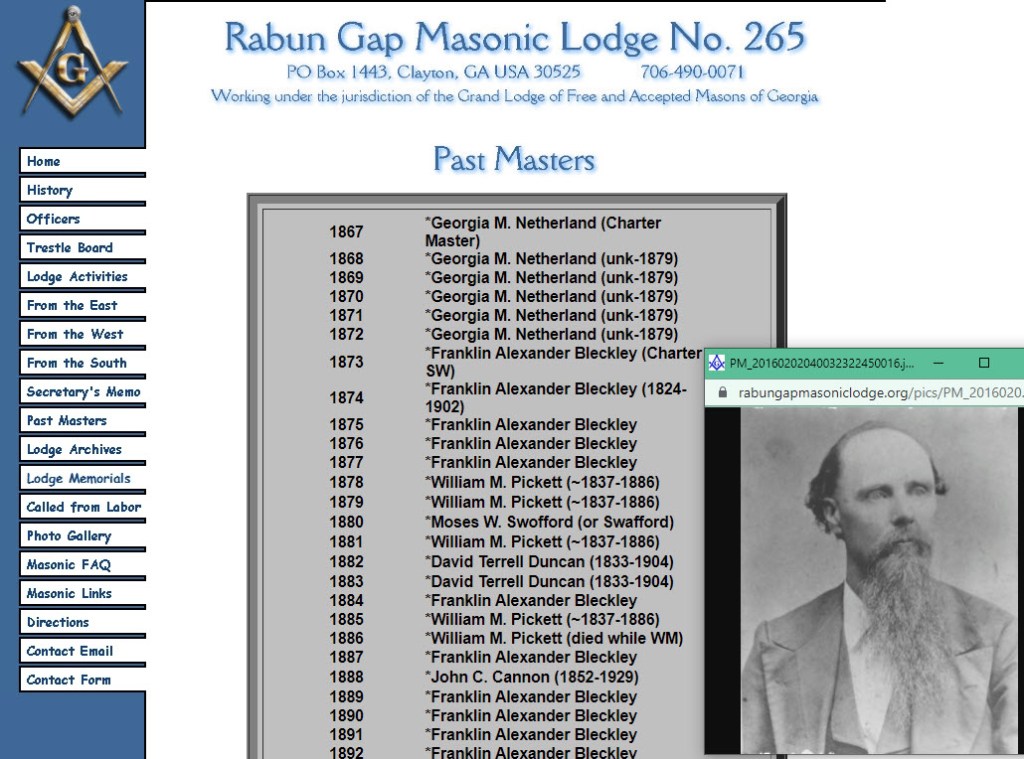
Rabun Gap Masonic Lodge No. 265 List of Past Masters

1890 US Census was destroyed in a fire and there are no records for David T Duncan available.

In the 1900 Census David is 66, Jane is 65, Lizzie is 41, Eliza J is 33, Ida is 25, Effie A is 24 and there is another son Haralson E. aged 18.  Haralson Earl will later be known as Harry Duncan.  There is also a housekeeper named Lavinia M aged 18. 

On August 15, David is named Postmaster for the Clayton post office in Rabun County.  He stays in this position for 1900, 1901 and 1902.
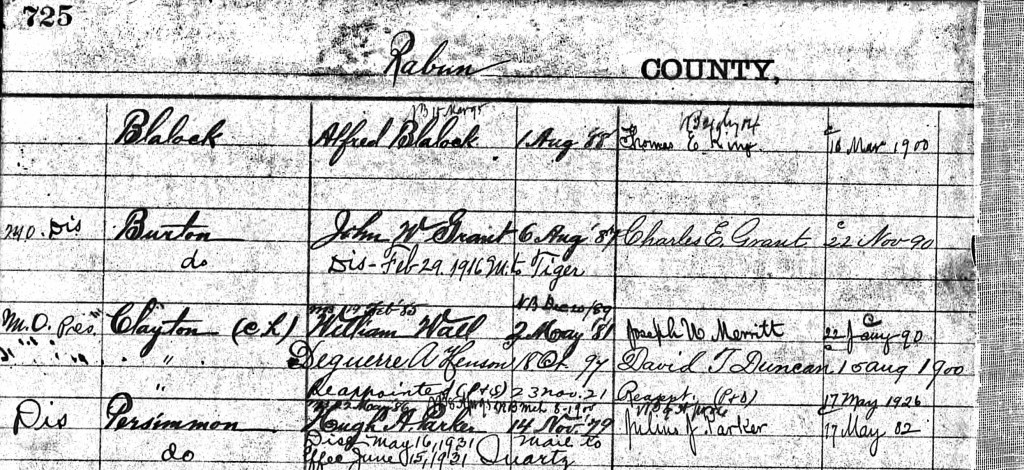
Rabun County, Clayton post office PostMaster appointment sheet - David T Duncan 1900

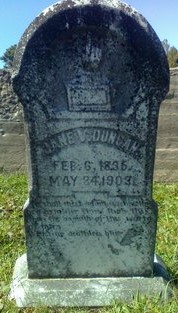
On May 24, 1903 David’s wife Jane passes away at age 68.
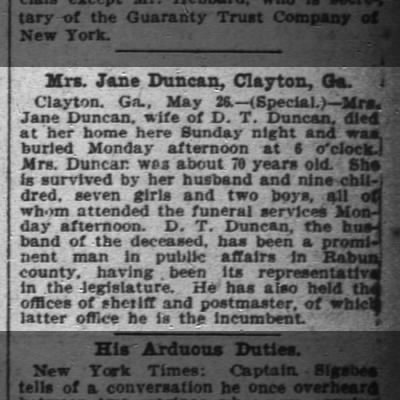
Jane Veronique Caminade Duncan Obituary 1903

David Terrell Duncan dies on July 9,1904, at the age of 71, and is buried in the Clayton Baptist Church Cemetery.  His headstone features a mason symbol and the epitaph, “Kind father of love thou art gone to thy rest forever to bask mid the joys of the blest”.
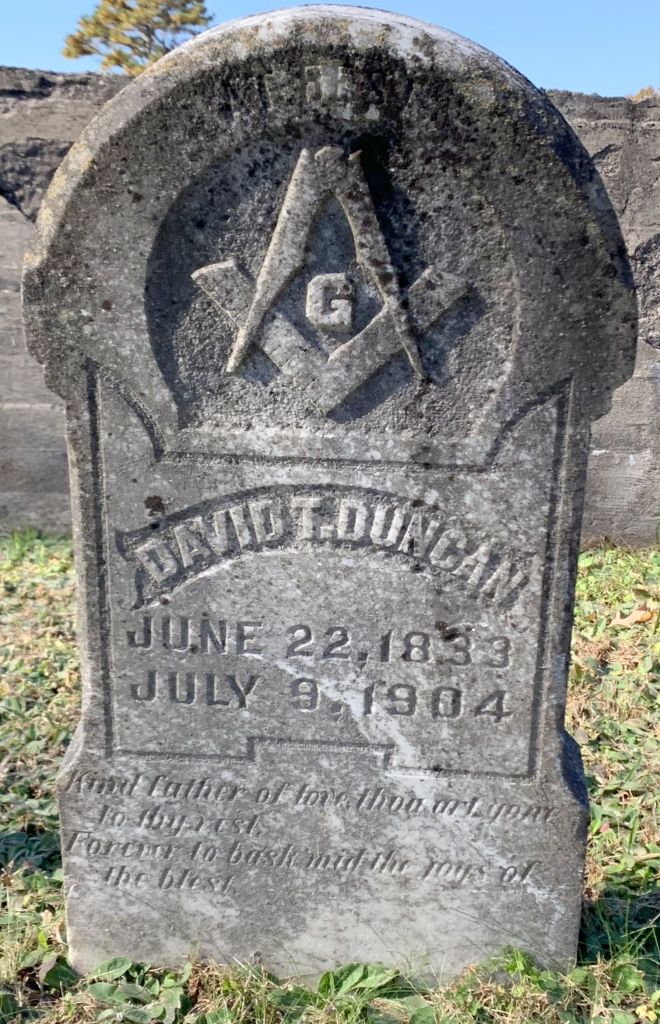
David T Duncan (1833-1904) headstone
Jane V Duncan (1835-1903) headstone

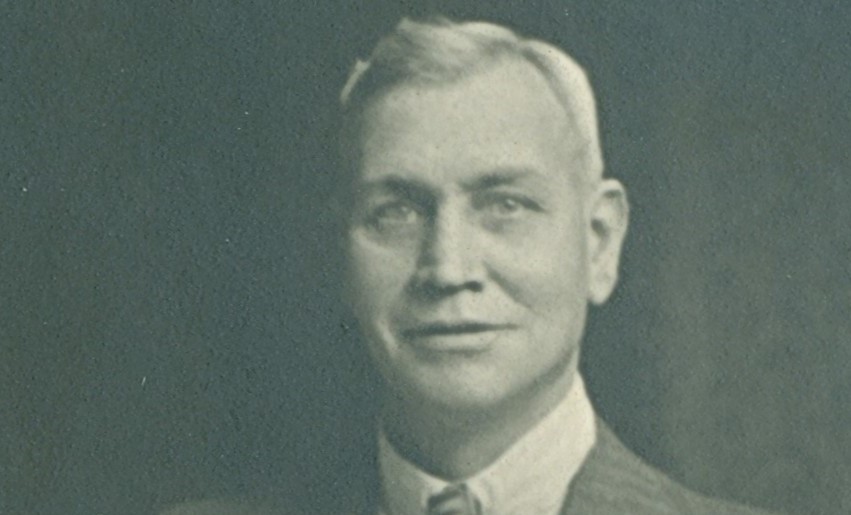
Robert Henry Heads (1877-1961)

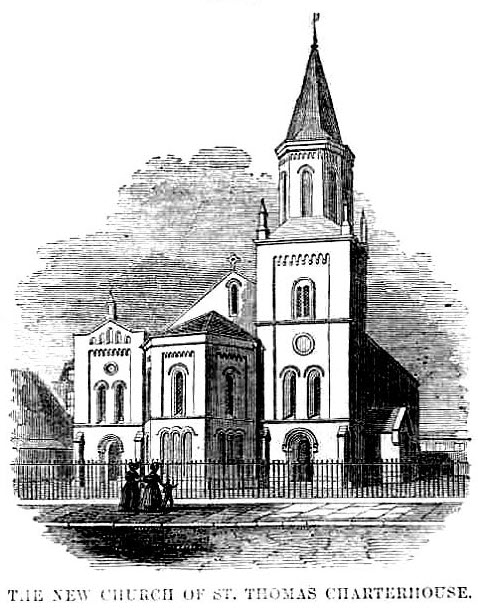
Robert Henry Heads was born May 3, 1877 and Baptized on June 10, 1877 at the Parish of St. Thomas Charterhouse in Middlesex, London, England.  The church was demolished in 1909, but was located just north of St. Paul Cathedral. 

The new church of St. Thomas Charterhouse
St. Thomas Charterhouse 1909 demolition

Robert’s parents, Henry and Eliza (Mary Eliza) Heads listed their abode as 9 Eagle Place on Bunhill Road on his baptism record.  Robert’s father, Henry, was a Boot Finisher and 25 years old at the time.  Robert’s mother, Eliza was 21.  Robert was the third child and the second son when he was born.  His older sister Ann Matilda Heads was 4 years old and his older brother John Henry James Heads was 2.

Robert is considered a true Cockney as he was born within the sound of Bow Bells.  St Mary-le-Bow church is located within a mile of where Robert was born and baptized.  He was born so close to the bells that even with the modern ambient noise levels which have reduced the area where the bells can be heard, he would still be considered a true Cockney.  Since there are no maternity units within the area, the likelihood of any “true” cockneys being born after the 2012 sound map was produced, is reduced significantly.

the sound of Bow Bells
2012 sound map showing the original area where Bow Bells could be heard and the 2012 reduced area
Line number 1555 in the baptism record of St. Thomas Charterhouse Henry & Eliza Heads son Robert

The 1881 census, shows that the family is now located at 26 Central St. in Finsbury area of London.  Robert is 4, Annie 8, John 5 and there is new little sister named Eliza aged 1.  Robert’s father Henry (29) is still listed as a Boot Finisher and Robert’s mother Eliza is listed as a 26-year-old Sorter (Wastepaper).

At the age of 11, Robert visited Scotland, it had a profound impact and he talked about this visit most of his life.

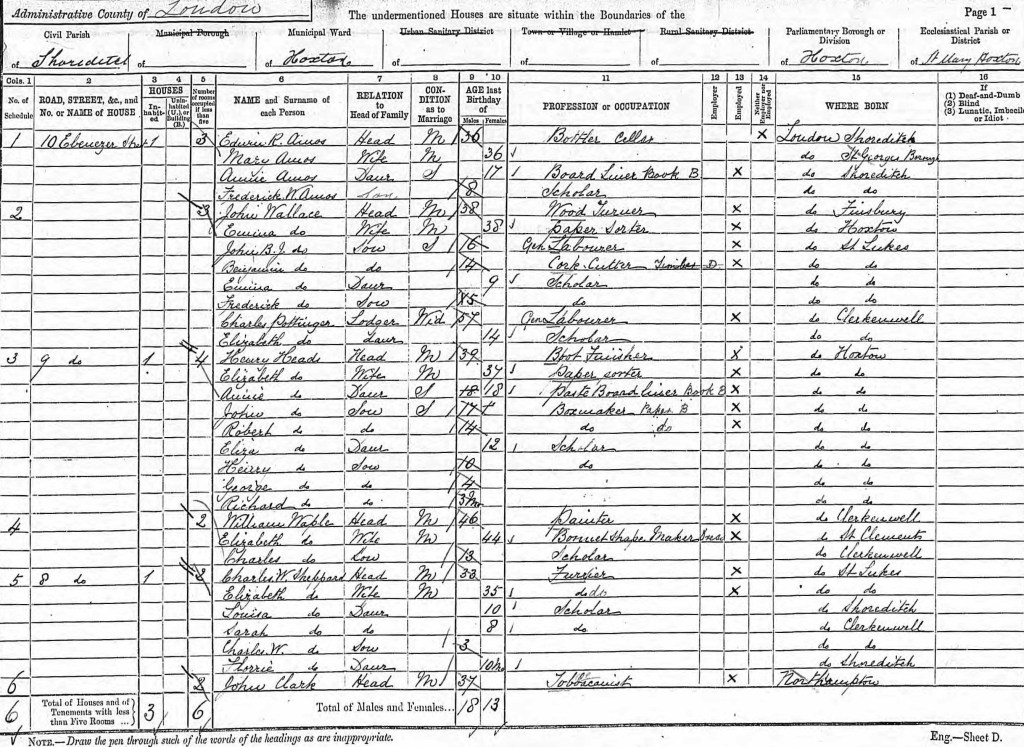
The family moves once again prior to the 1891 census, they now live in Shoreditch Parish of the municipal ward of Hoxton at 9 Ebenezer Street.  Father Henry is a Boot Finisher and 39, mother Eliza at 37 is a Paper Sorter. Annie is 18 and a Paste Board Liner (someone who passes cardboard into a pasting machine), John 17 and Robert 14 are both Boxmakers, Eliza 12 and Henry 10 are listed as Scholars.  The youngest Heads, are George 4 and Richard 3 months.

1891 Census Henry & Elizabeth Heads and family

I am not able to find the 1901 England census for Robert Heads.  However, there is a Robert Heads listed as a Boot Finisher, born in England, who is a boarder at 22 Gellatly St. in Dundee, Scotland as part of the 1901 Scotland census.  It is possible he returned to Scotland after Robert’s mother Eliza (Mary Eliza) died in 1899 and his father Henry Heads remarried. Robert’s step mothers name was Elizabeth (like his own mother) and she had a daughter, also named Elizabeth (Boney).  By the 1901 census, Robert’s father lives with his new wife and step daughter.  Robert’s brothers and sisters all went on to different lives.

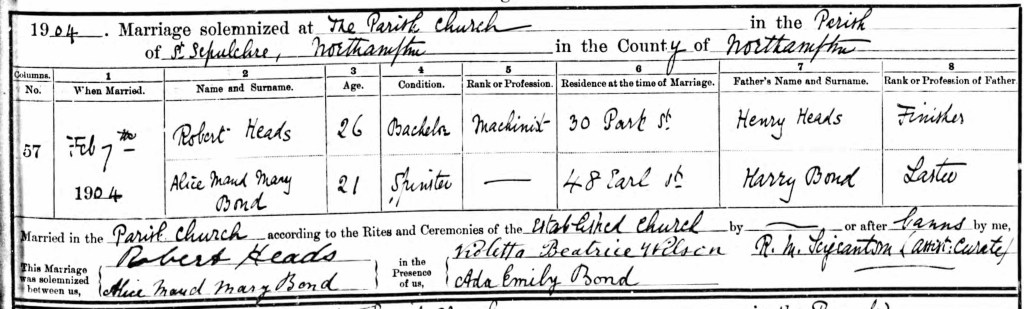
The next official document for Robert Heads is when he marries Alice Maud Mary Bond on Feb 7th 1904 at the Parish Church of St. Sepulchre in Northampton.  Robert, age 26, is a Machinist living at 30 Park St.  Alice Maud Mary Bond is living at home on 48 Earl St.  Prior to living on Earl Street, Alice’s family lived at 24 Park St., which is probably where Robert met Alice.  I assume Robert moved to Northampton to pursue a career in the Boot and Shoe Industry which was growing quickly in Northampton at the time. Witnesses at the wedding were Violetta Beatrice Wilson (the bride’s sister-in-law) and Ada Emily Bond (the bride’s sister).

Marriage register The Parish Church of St. Sepulchre Northampton for Robert Heads and Alice Maud Mary Bond February 7, 1904

On July 26, 1904, Emily Ellen Heads is born.  And by the 1911 census Robert’s family lives at 7 Somerset St. Northampton.  Robert is 33 and a Shoe Finisher.  His wife Alice is 28, Emily is 6, son Albert is 4, daughter Alice is 3.  There were 2 children that died in 1911, Annie and John were twins less than a year old.

1914-1918 WW1.  Currently unknown how Robert served during WW1.  On Feb 19, 1918, Gladys Irene was born.

left to right, the Heads family approximately 1923 Alice, Robert, Emily, Gladys, Albert and Alice Maud Mary

In the 1939 register, Robert (age 62) and Alice (age 57) are living at 61 Bryant Rd. Kettering.  Robert is listed as a commercial traveler in shoe trade accessories government controlled.  Gladys, age 21 is living with them.  She is a Wholesale Confections Clerk and about to marry Ted Tite in 1940.

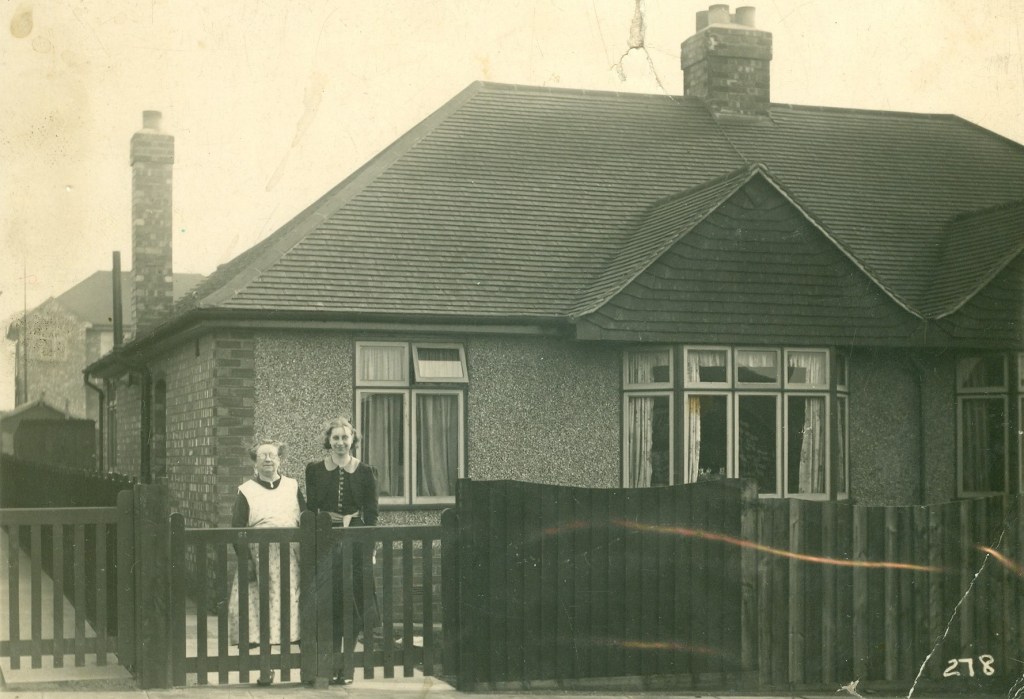
61 Bryant Rd. Alice Maud Mary Heads and Gladys Heads, approximately 1939

Robert is part of the Home Guard during WW2 from 1940-1944.

At the end of WWII, in 1944, Robert took his granddaughters, Joy and Janet to London to walk around and see what had happened to London during the war.  The Bow Bells were bombed in May 1941 and did not ring again until December 12, 1961, after Robert died.  They stopped by The Elephant and Castle Pub, to pick up some beer before visiting Robert’s sister Eliza Howatt and her daughter Dolly at 68 Cropley St., London.  When the buildings began to be knocked down in about 1958, Eliza and Dolly moved across town to Clinger Court, an 11 story building (considered a high rise at the time).

Robert dies on Jan 6, 1961 at the age of 83 and is cremated on Jan 10 in Northamptonshire. While the official probate is shown below, all of the children and grandchildren received something upon his death.

Probate of Robert Heads March 15, 1961 (he died on January 6, 1961)

John Parkinson (1841-1915)

John Parkinson was born in December 1840 in Gas Street (now Meadow Road), Kettering.  The official index recording his birth is dated 1841 Jan-Feb-Mar.  However, the 1841 Census shows he was 6-month-old on June 6, 1841 and family history states his birth year as 1840.  He was the third son (of four children) of William Parkinson (age 36) and Mary Ann Curtis (age 32).

When John was 6 months old, his mother Mary took he and his 9-year-old brother Thomas to visit her parents, Philip Curtis and Ann Dorothea Mobbs, in Bedworth.  Bedworth being a small market town in Warwickshire about 40 miles from Kettering.  She would have had to take horse drawn transportation of some kind to get there as trains and cars were many years away.  John’s father William stayed home with William Jr who was 3 years old at the time.  We know this because the 1841 census was taken on the night of June 6, 1841.  It shows Philip and Ann Curtis, Thomas and William Curtis (2 of Mary’s brothers), Mary, Thomas and John Purkenton.  She identifies herself as a Silk Weaver.  Her parents are Ribbon Dealers and Ribbon Weavers, which was a common occupation near Coventry at the time (Bedworth is only 8 miles from Coventry).

On March 30, 1851, John is a 10-year-old scholar, at home on Gas Street, with his 8-year-old sister Sarah, his 13-year-old brother William Jr (a Shoe Closer) and his mother, Mary (she is 42).  John’s father William (46), a Tailor, is visiting Gretton, a village just north of Corby.  This was a Sunday and in addition to the regular Census a special Census of Religious Worship was recorded.  William attended service at one of these 3 churches in Gretton on that night: St. James, Ebenezer Baptist Chapel or Wesleyan Chapel.

At the age of 16, John Parkinson worked for Gotch, a boot and shoe manufacturer.  He became apprenticed with Fred and John Mobbs at the age of 17 and joined Mobbs Band as junior cornet player.

In 1861 John took over playing the big drum and played with Mobbs Band, Kettering Rifle Band and the Kettering Town Band.  He continued to play the drum for 50 years until his age and infirmity caused him to be unable to handle the drum sticks. {Desmond Newell}.  John was a shoemaker and still living at home in 1861.  In previous Census, the address where the family lives is listed as Gas Street.  However, in 1861, the address is listed as Castle Hill and Stamford Rd.  Mary is 52 and her occupation is Tailor’s wife.  William, Jr. (23) is a shoemaker also at home.  And Sarah Ann is a shoe closer at 18.  John’s father is again not at home.  William (56) is visiting a Whitesmith named William Turner in Little Weldon and he identifies himself as a Tailor.

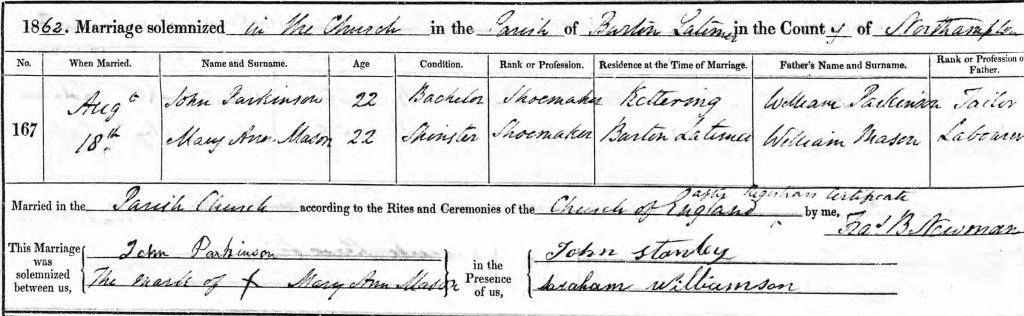
John marries Mary Ann Mason from Burton Latimer on August 18, 1862 at the parish church.  Both are 22 years old and shoemakers at the time.  Both of their fathers sign the marriage license along with witnesses John Stanley and Abraham Williamson.  Mary Ann signs with an “X”.
August 18th 1862 Marriage record of John Parkinson and Mary Ann Mason in the Parish Church Burton Latimer

By the time of the 1871 census, John and Mary Ann are living at #5 Green Lane Terrace, Kettering, where they will live for the next 45 years.  Mary Ann is no longer working outside of the home as she is taking care of Harry (age 8), Lizzie (age 6) and Tom (age 4).  The day of the census, Mary’s youngest sister Ellen Mason (age 17 shoe fitter) is also at the house on Green Lane Terrace.

Kettering Town Band 1870’s

The 1881 census shows John (40) and Harry (age 18) as shoe finishers, Lizzie (16) is a shoe fitter, Tom (14) shoe finishers assistant.  Mary Ann (40) and John have two more daughters, Nellie who is 9 and Rose who is 5.

Kettering Town Silver Band 1880’s

John, at age 50, lists himself as the employer and a shoe manufacturer on the 1891 census.  Mary Ann is also age 50.  Lizzie (26) is a shoe fitter, Nellie (19) and Rose (14) are shoe machinist’s and there is another daughter Annie who is 8.  There is also a 6 month old grandson named Fred Parkinson at the house on Green Lane Terrace.  However, there is no record of who are his parents and the next Fred Parkinson is not born until 1907.  Interestingly, I can not find a record of John and Mary Ann’s son Thomas and his wife Emily during the 1891 census.  Is it possible that they lost their first son and re-used the name at a later time?

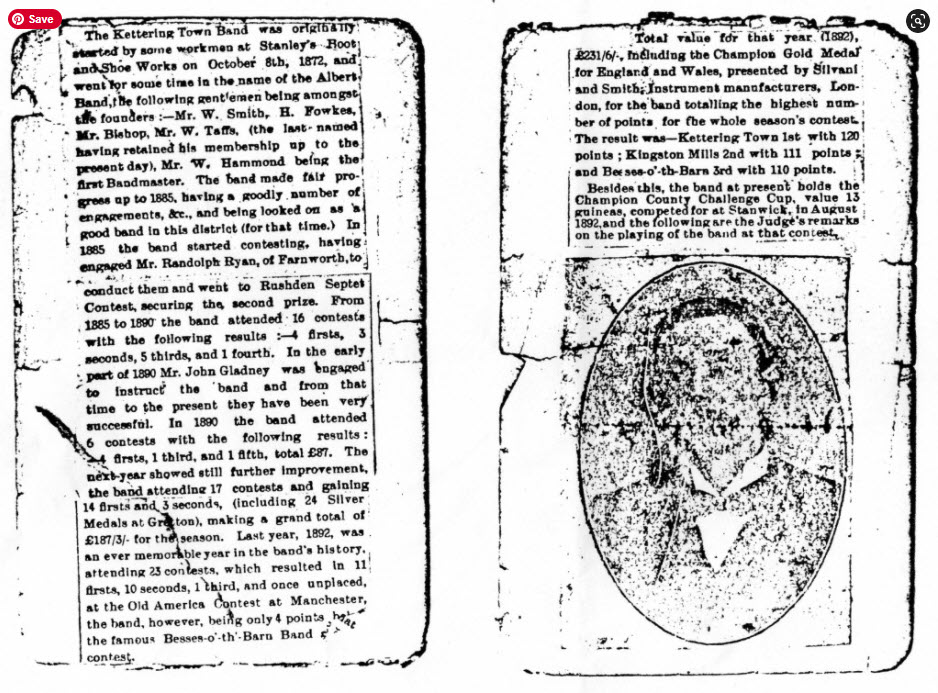
Kettering Town Band article from 1893

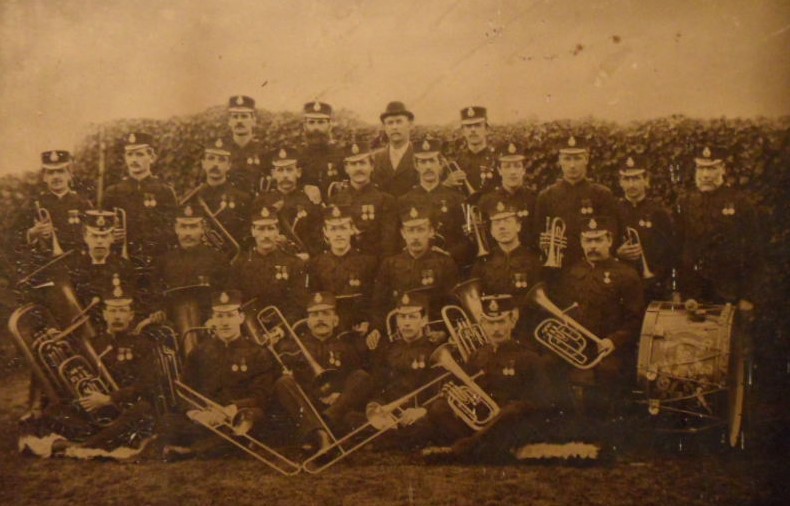
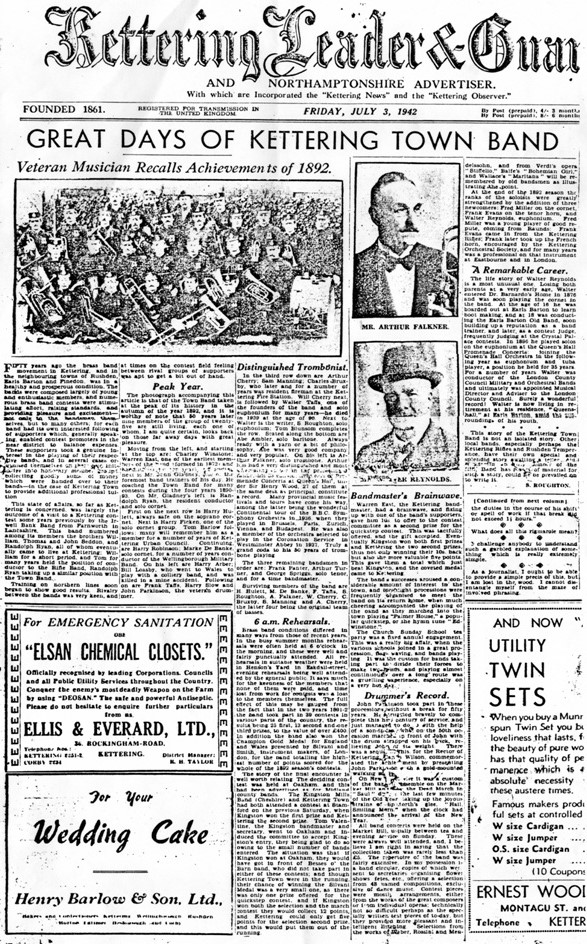
In 1892, the Kettering Town Band had the most memorable year in the band’s history, attending 23 contests, which resulted in 11 firsts, 10 seconds, 1 third, and once unplaced, at the Old America Contest at Manchester, the band, however, being only 4 points below the famous Besses o’ th’ Barn Band at that contest. Total value for that year (1892), £231 6s, including the Champion Gold Medal for England and Wales, presented by Silvani and Smith, Instrument manufacturers, London, for the band totaling the highest number of points for the whole season’s contest.  John Parkinson was the drummer. Photograph is at the top of this blog post.

At age 60, John now has a job as a cleaner in the shoe factory.  Mary Ann is also age 60 and listed on the 1901 census.  Lizzie, now 36, is a shoe fitter and Annie, now 18, is a shoe machinist.

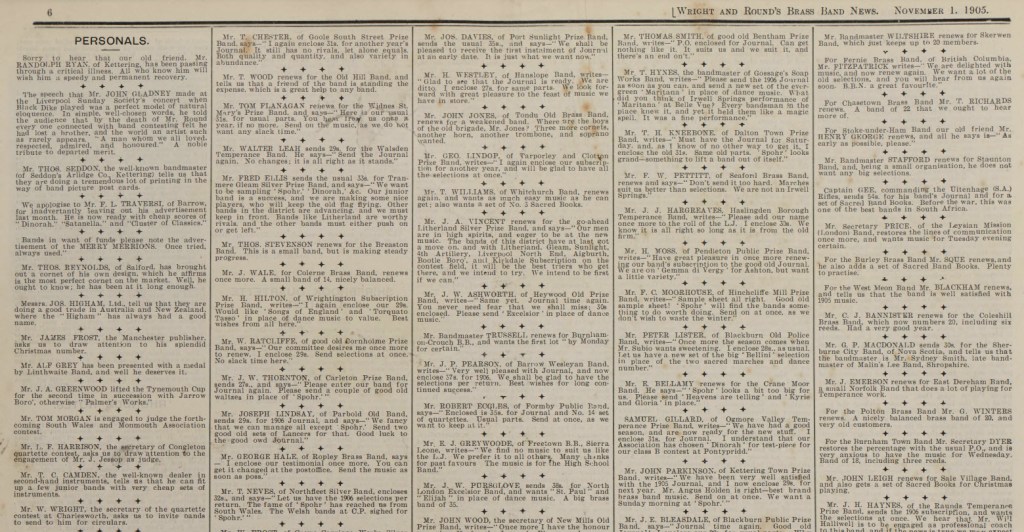
Personals Wright and Round Brass Band News 1905 – John Parkinson

The 1911 census shows that John (now 70) and Mary Ann (now 69) are by themselves at #5 Green Lane.  John lists himself as a retired shoe finisher.  The census shows that they had 6 children and 4 are still living.  Harry died in 1906 and Lizzie in 1909.  This is also the year that John received a gold encrusted watch for completing 50 years as a drummer in the Town Band.

Mr. and Mrs. Parkinson celebrated their Golden Wedding on 12th August 1912.

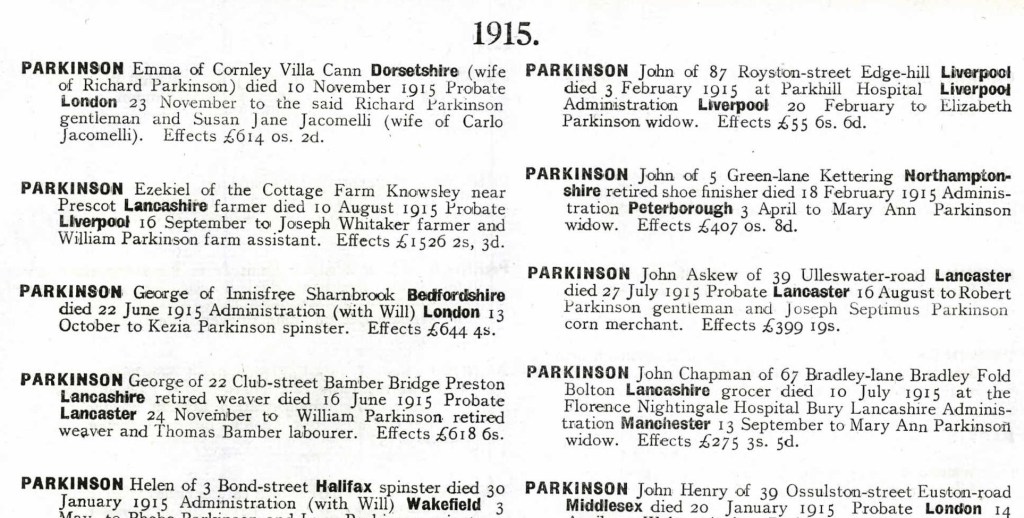
John Parkinson died on February 18, 1915.

1915 Probate of John Parkinson

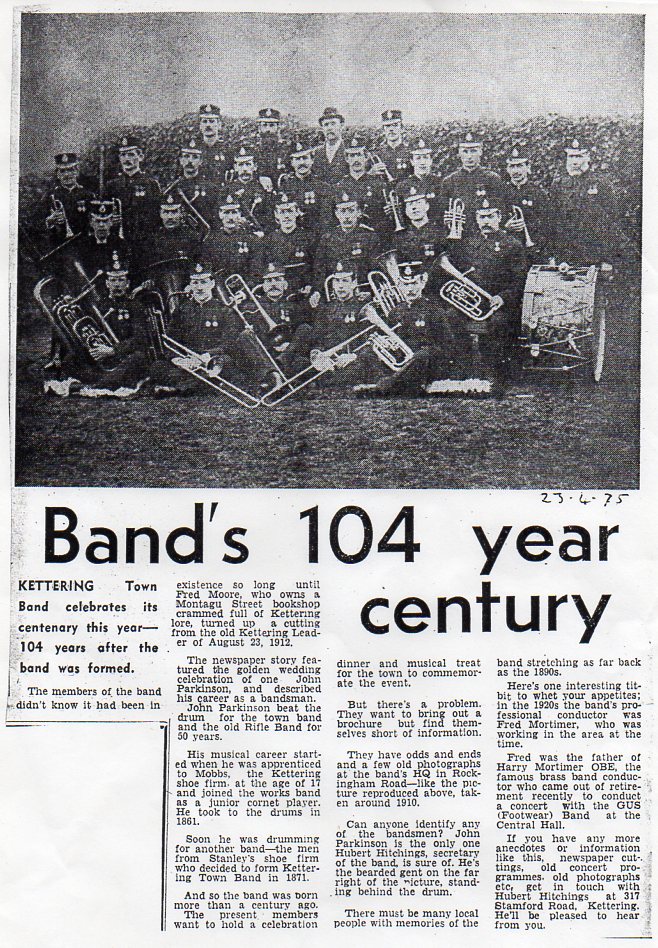
In 1975, the Kettering Town Band celebrated it’s centenary year, 104 years after the band was formed.  The members of the band didn’t know it had been in existence so long until Fred Moore, who owns a Montagu Street bookshop crammed full of Kettering lore, turned up a cutting from the old Kettering Leader of August 23, 1912.

The newspaper story featured the golden wedding celebration of one John Parkinson and described his career as a bandsman.

John Parkinson beat the drum for the town band and the old Rifle band for 50 years.

His musical career started when he was apprenticed to Mobbs, the Kettering shoe firm at the age of 17 and joined the works band as a junior cornet player.  He took to the drums in 1861.

Soon he was drumming for another band – the men from Stanley’s shoe firm who decided to form Kettering Town Band in 1871.

And so, the band was born more than a century ago.

Kettering Town Band 104 year centenary 1975
Great Days of Kettering Town Band 1942

Eliza Ann Stroud Holt (1842-1919)

Eliza Ann Stroud is the oldest child of Peter E. Stroud and Mary Pollie Gibbs of McDowell County, NC. Eliza was born the same year that McDowell County was formed from Burke County. The family lived on the south side of the Catawba River and west of the North Fork. This is somewhere just north of the current Marion, NC, which was also founded when Eliza was 2 years old. Also in the area is Lake James, a backdrop for movies such as The Last of the Mohicans and The Hunt for Red October.

According to the 1850 census, Eliza’s father, Peter, was a farmer in McDowell County North Carolina. She had two younger brothers (William and D.E.) and a younger sister M.E.

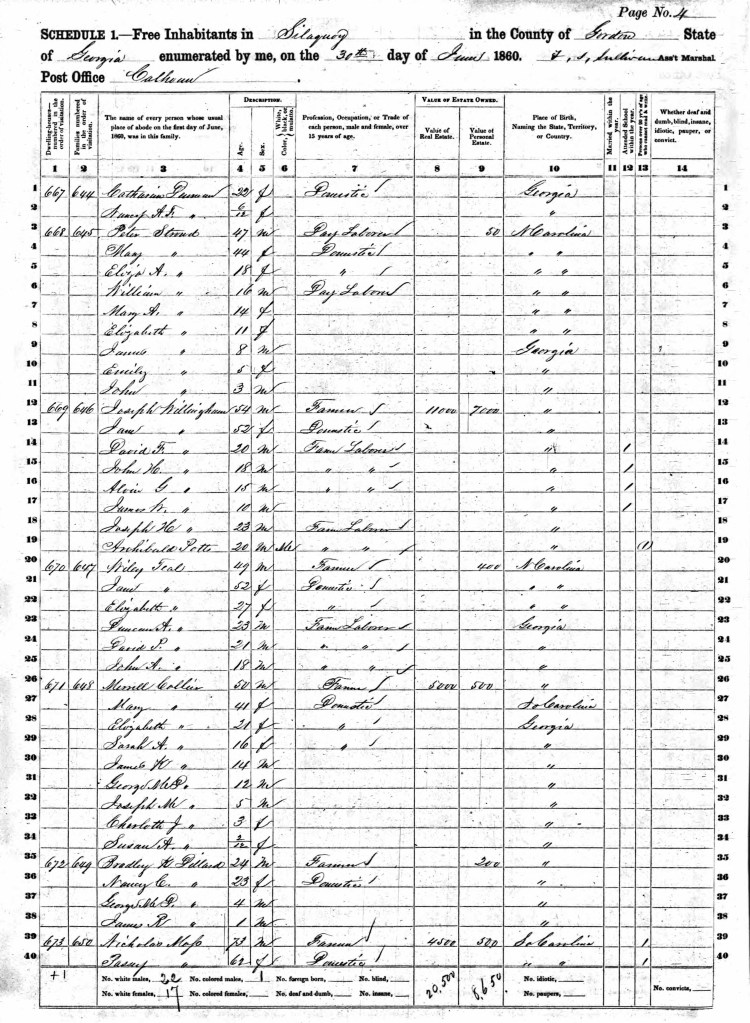
By 1860, the family was located in Silaquoy in Gordon County, GA. (the post office was Calhoun). Eliza’s father, Peter, and her brother William are now listed as day laborer’s. Eliza and her mother, Mary, are domestic’s, with the younger brothers (James and John) and sisters (Mary A., Elizabeth and Emily) too young to have occupations. Since the three younger children were all born in Georgia, the family probably moved to Georgia from North Carolina between 1850-1852.

1860 Census of Silaquoy, which was part of Gordon County, GA

During the Civil War years of 1861-1865, Eliza was in her early 20’s. Her father, Peter is more than 45 years old when the war started, that was considered too old to serve. There are a couple of Peter Stroud’s recorded as being part of the Georgia militias, however, neither one is a good match for Eliza’s father.

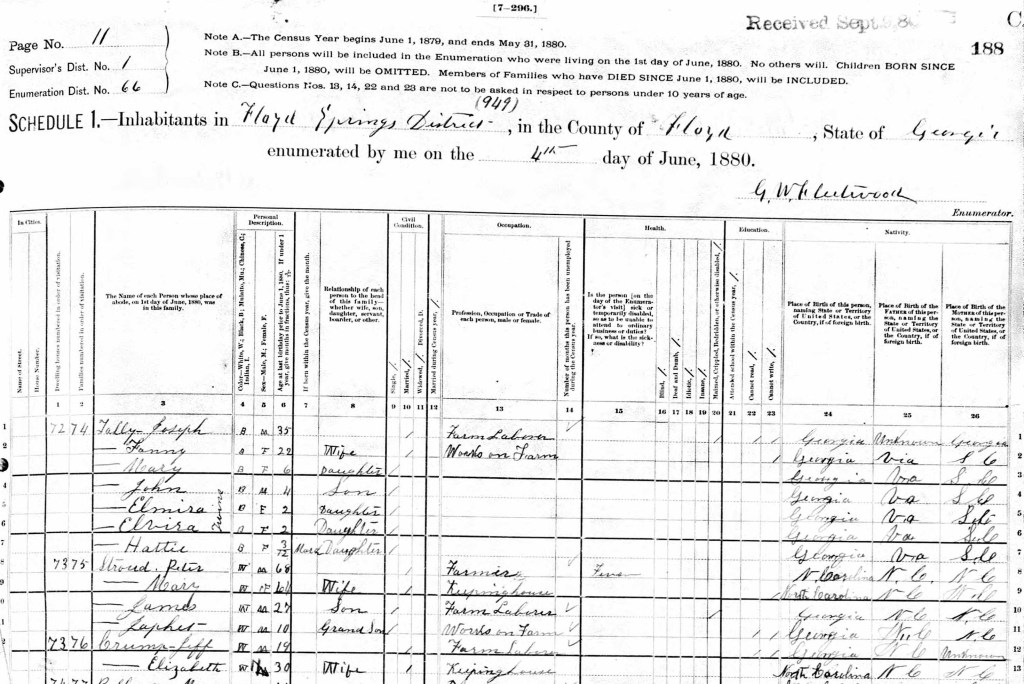
In 1870, the family was located in the 825th District, Murray County, Georgia (post office is Spring Place). Eliza, her father, sister Elizabeth and brothers James and John are all listed as farm laborer’s. Mother Mary is keeping house. There is also a 7 month old baby boy named Japhet. In a later census, Japhet is listed as Peter and Mary’s grandson. Holt family history states that Japhet is Eliza’s son, but he is not related to the Holt’s. At this point, Eliza’s brother William doesn’t show up on any 1870 census, however, he reappears in 1880. Eliza’s sister Emily don’t appear in any records after the 1860 census.

According to the 1900 census Eliza and James Crawford Holt are married in 1874. Eliza would be 27 and James Crawford Holt would have been 20. Eliza’s son Japhet/Joe would have been 5 years old.

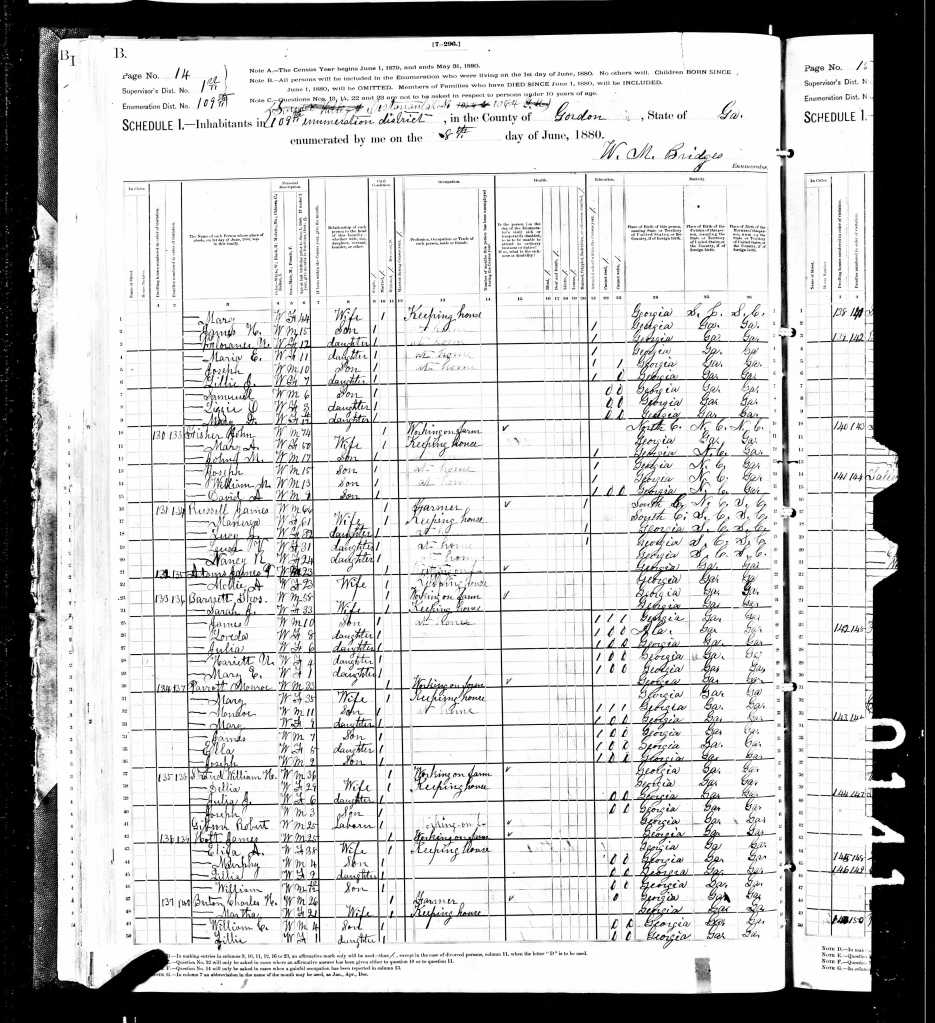
In the 1880 census, James is working on the farm and Eliza is keeping house. They have 3 children, Murphy is 4, Lillie is 2 and William is 10 months old. It says that everyone was born in Georgia, including their parents. They are living in Oostanaula, Gordon County, Georgia Militia District 1064, 109th Enumeration District. Back in Floyd Springs, Eliza’s father, Peter, her mother, Mary, and brother James appear on their last census documents. Her father Peter was sick with the fever when the census taker was at the house in June 1880.

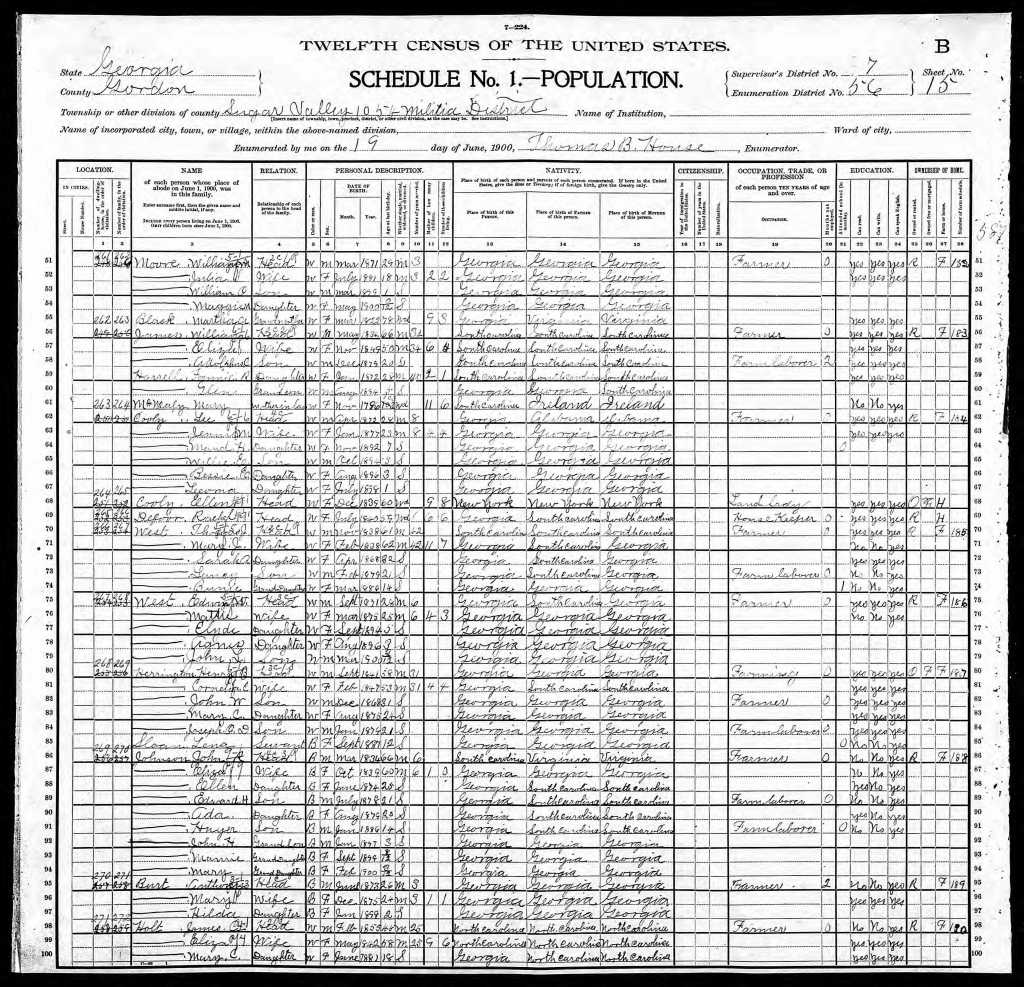
According to the 1900 census, James C (born in Feb 1855 in North Carolina) is in Gordon County, Georgia, Militia District 1054, Sugar Valley, enumeration District 0056. It states that he and Eliza (born in May 1842 in North Carolina) have been married 25 years (in 1875). She had 9 children and 6 are still living (Joe, John, Lillie, William, Mary, James). It also states that Eliza can read and write. All four of their parents were born in North Carolina. Also in the household are Mary C (June 1881, born in Georgia) and James D (April 1885, born in Georgia). James C is listed as a farmer, renting his home and James D is listed as a farm laborer.

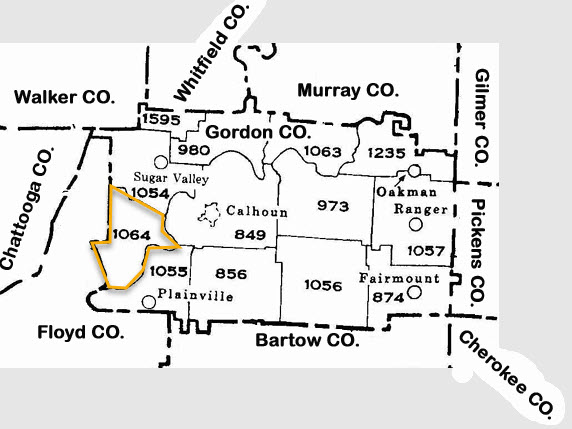
In 1910, James C (55) and Eliza (67) are living on Rock Creek Rd, Oostanaula District 1064, Gordon County, Georgia where he is listed as a general farmer.

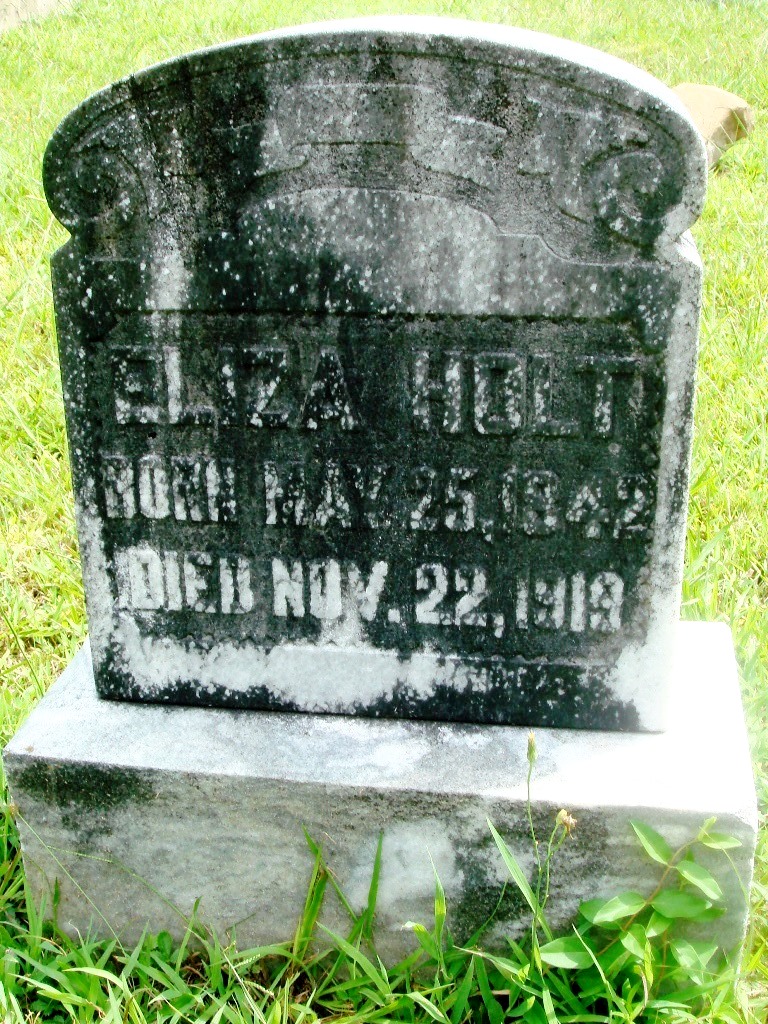
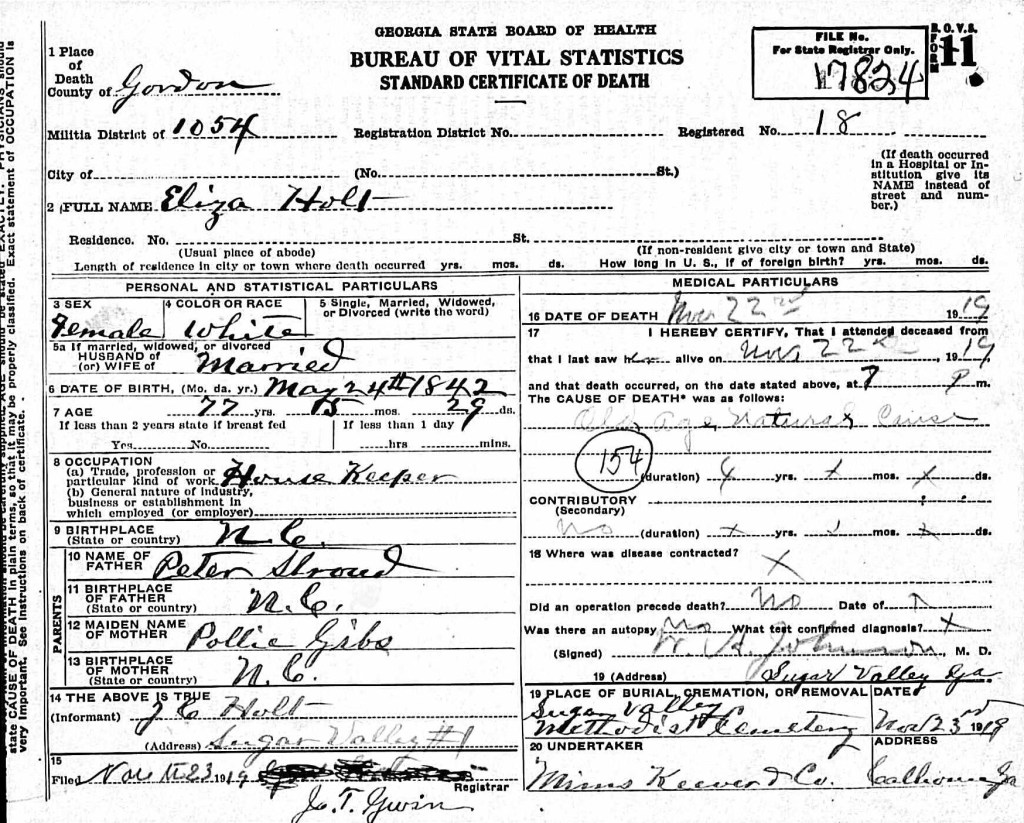
According to her death certificate, Eliza dies on Nov 22, 1919 of old age with no complications. She was 77 years old. She died in Sugar Valley and was buried in the Methodist Cemetery on Nov 23.

gravestone located in Sugar Valley Methodist Cemetery in Georgia

Eliza’s son Joe, married Alpha Cornilla Akins (Aunt Effie to Vergil Henry, the younger). They had several children; the youngest daughter was Annie Josephine Stroud. She married William Arthur Bartlett. Their youngest daughter Helen Inez Bartlett married James Crawford Holt (one of Eliza’s grandsons).
According to Vergil Henry, Joe Stroud was mean to Vergil’s father, John Murphy Holt. Vergil’s grandfather (James Crawford Holt: Eliza’s husband) finally made him move out because of John Murphy’s complaints of him. Joe tried to take the last name of Holt, but Vergil’s grandfather (James Crawford) would not allow this either. After Joe died, Aunt Effie visited Vergil Henry’s parents frequently.

James Crawford Holt (1854-1926)

According to the 1860 Census, James C Holt (4 years old) was born in 1856 in North Carolina. His father, John Calvin Holt, was a 22-year-old farm laborer born in Georgia. His mother, Caroline Stratton, was 24 and had also been born in North Carolina. At this time, the household also contained Margaret M who was 2 years old and born in North Carolina and Lora J who was one and born in Alabama. The family had no real estate and had a net worth of $100. It was July 4, 1860 and they lived in the Georgia Militia District 972, in Murray County, Georgia (post office: Rock Creek).

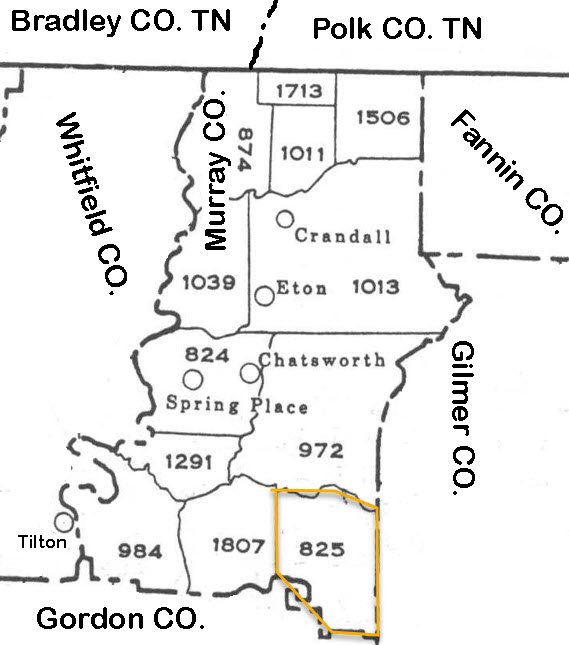
In 1870, James C is 15 (born 1855 in North Carolina). His father is not on the 1870 Census as he died from smallpox in 1862 while fighting for the Confederacy in Virginia. His mother, Caroline (from North Carolina) is now 35 and keeping house. James C and his sisters; Margaret (14, born in North Carolina), Laura J (12, born in Alabama) and Nancy A (10, born in Georgia) are all farm laborer’s. Mary E, age 7 and born in Georgia, is at home. The family is located in Militia District 825 in Murray County, Georgia, the closest post office is Spring Place.

1870 Census map of locations where James Crawford Holt lived in 1860 (972) and 1870 (825)

According to Vergil Henry, the younger’s, account, James Crawford Holt married Elizer Stroud who had one son name Joe Stroud already and lived at home with her parents. She was 27 in 1874, a bit older than James Crawford Holt was.

James, at 25, has his own family in the 1880 census and is working on the farm. His wife, Eliza A, is 38 and keeping house. They have 3 children, Murphy is 4, Lillie is 2 and William is 10 months old. It says that everyone was born in Georgia, including their parents. They are living in Oostanaula, Gordon County, Georgia Militia District 1064, 109th Enumeration District.

1880 Census showing James Crawford Holt, Eliza A, Murphy, Lillie and William

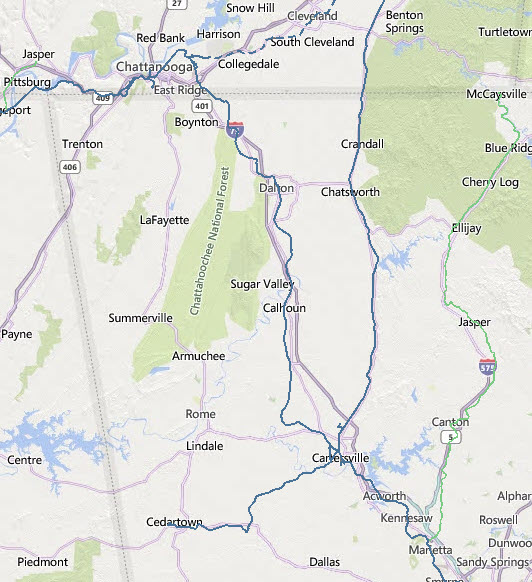
James C and his son John Murphy worked for years as timber cutters for the railroad. They cut the timber for cross ties located between Cartersville, GA and Tennessee.

Railroad line from Cartersville, GA to Chattanooga, TN

According to the 1900 census, James C (Feb 1855 in North Carolina) is in Gordon County, Georgia, Militia District 1054, Sugar Valley, enumeration District 0056. It states that he and Eliza (May 1842 in North Carolina) have been married 25 years (in 1875). She had 9 children and 6 are still living. All four of their parents were born in North Carolina. Also in the household are Mary C (June 1881, born in Georgia) and James D (April 1885, born in Georgia). James C is listed as a farmer, renting his home and James D is listed as a farm laborer.

1900 Census with James Crawford Holt family at the bottom (this continues on the next page with James D Holt)

In 1910, James C (55) and Eliza (67) are living on Rock Creek Rd, Oostanaula District 1064, Gordon County, Georgia where he is listed as a general farmer.

1910 Census map of Oostanaula District 1064, Gordon County, GA where James Crawford Holt lived in 1910

James Crawford Holt’s wife Eliza died on Nov 22, 1919 in Sugar Valley, GA and was buried in the Sugar Valley Methodist Cemetery on Nov 23. In 1920, a large portion of the family moved to the Chula, GA area where John Murphy Holt (James Crawford & Eliza’s oldest son) had accepted a position to care, prune and graft a large field of peaches for an affluent man. James Crawford either went with them or joined them later.

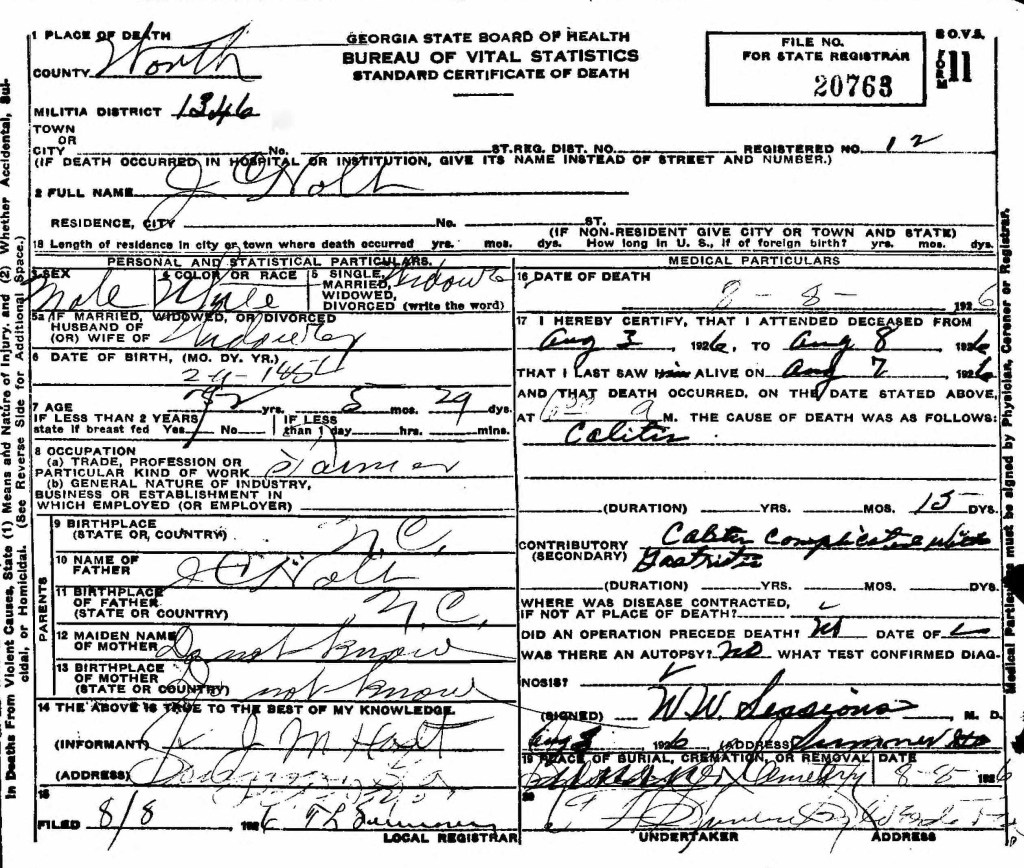
According to the death certificate dated Aug 8, 1926 from Militia District 1346 in Worth County (Sumner, GA), J. Holt was born on Feb 9, 1854 in North Carolina. It says his father’s name was J.C. Holt from North Carolina and the informant J.M. Holt (assuming this is John Murphy Holt) did not know the name or birth location of J. Holt’s mother. This makes him 72 years, 5 months and 29 days old. He is listed as a widowed farmer that died of colitis complicated with gastritis after being attended by Dr. W.W. Sessions of Sumner, GA for 5 days. The family believes he died of the fever. Buried at Sumner Cemetery, Calvin & Aline Henry’s stillborn baby was buried in the same cemetery 3 weeks later (J.M. Holt was the informant of this also). Vergil Henry, the younger, states the cemetery is just south of Highway 82, west of Sycamore, GA in an almost forgotten graveyard which he visited with his mother, Annie Lillian King Holt, and showed her the area of their unmarked graves (would have been before 1983).

James Crawford Holt death certificate dated Aug 8, 1926

Baby Cardinals

If I didn’t see it for myself, I would have though that the baby bird needed to be put back in it’s nest. For the last 4 weeks, I have been watching a pair of cardinals out my kitchen window. They set up house in a bush to the left of my kitchen window. The bush is a Dracaena reflexa ‘Variegata’ called Song of India. In most areas of the country this would be a houseplant. Here, they are just another outside bush (see below, behind the yellow orchid). While we have had birds nest in our yard before. This was my first songbird family. I was excited and afraid for them.

We spent the first week making sure that the bush was perfect. When the lawn service showed up, I was sure that they were out. But, they both came back. The bright red male feeding the female while she laid eggs. I kept trying to see if everything was ok, but had trouble seeing from the window. And whenever I went around the side of the house, both of them flew to the fence and tried to get my attention away from the nest. And then the other birds and Chloe would get curious, so I tried to avoid the side yard.

This week, we had yard service on Monday and pressure washers on Tuesday… I was sure nesting would be over. But, this morning both parents were busy feeding babies. The whole family was loud today. I could see movement at the top of the bush. And then I could see one of the babies! Just sitting there. Both parents were hopping up and down in the bushes across the path. Then, the baby cardinal fledged… just like that. It was the ugliest baby bird I have ever seen. No tail feathers, just a round semi-bald fuzzy ball sitting on the pathway. Had I not seen it myself, I would have thought it fell. The parents flew up and down in front of the baby, I think they were showing it what to do. Then, it flew…all of 18 inches and maybe 3 inches off the ground. A couple of small flights later, it vanished from my sight. The parents can obviously still see it, they are back to bringing food. Now in both the bush (I think there are two more) and on the ground around the white bird of paradise.

I have read that the baby cardinals should be able to fly well enough after 24 hours. I am keeping Chloe inside for the next couple of days. I feel like I have invested enough time and effort on the baby cardinals that if my dog ate them, I would be more than a little upset. While I love hearing them and they are beautiful to see, I think I can do without a bunch of stressful songbird nests in the future.

First Stone Crab Claws

We have been in Florida seven years and this is our first time trying Florida Stone Crab Claws. I bought a pound at Bedner’s Farm Fresh Market in Boynton Beach. As per normal, it was crowded even at opening on a weekday morning. Even with everyone being masked, I was glad to get outside.

We salted some water and boiled them for 10 minutes. Then used the meat hammer to crack the claws. Since we never have the need for specific shellfish crackers, we used the nut crackers and picks. They tasted good, but not sure we were completely in love with them.

I like the idea of Florida Stone Crab claws because they only harvest the one claw. The crab gets it back within a year and it gets to be big enough to harvest again in 3-4 years. While I’m sure sustainable doesn’t sound so great to the crab, options could be worse.

First COVID-19 Vaccine Day

Yep, today is the day I got my first COVID-19 vaccine “jab”. I think about this time last year…we were all so scared and clueless. I am glad that a vaccine was developed so fast. I made a personal choice to get the first vaccine that I could get. I was eligible last week. However, it was also the week that my Niece got married in another part of the state. That meant waiting until we got home before booking. Of course, the eligibility age dropped another 10 years in a week and we were concerned that so many people would be trying to sign up that it would take us forever.

I feel that I got super lucky. Just like trying to get concert tickets (my husband’s analogy, not mine) I was ready to refresh my screen at 7:00 am. At 7:04 am, I closely read the top of the page and realized that refreshing my screen just started the line timer over again….DUH! I waited 1 1/2 minutes more and the light turned green! YEA!!!!!! I was in. Was a good system on Publix website. They scheduled both the first and second shots a month apart. I already knew it was the Moderna vaccine as the timeframe I signed up only had that one option.

I counted down the days… well ok, I only waited from Monday morning to Wednesday lunchtime. I went to the grocery store and bought quick fix food items just in case I didn’t feel well after the first shot. My appointment was at 12:40 pm and I was ready to leave the house at noon. Publix is only 4 minutes away, but I wanted to be on time. I bought my husband some cereal and then checked in at the desk. After filling in a one page check in sheet, they took me to the Pharmacy. I was called to the counter and got my vaccine document. Then behind the screen and poof! much easier than I thought. After waiting 15 minutes to make sure I didn’t have a reaction, I was done.

Feeling good so far.