John Parkinson was born in December 1840 in Gas Street (now Meadow Road), Kettering. The official index recording his birth is dated 1841 Jan-Feb-Mar. However, the 1841 Census shows he was 6-month-old on June 6, 1841 and family history states his birth year as 1840. He was the third son (of four children) of William Parkinson (age 36) and Mary Ann Curtis (age 32).
When John was 6 months old, his mother Mary took he and his 9-year-old brother Thomas to visit her parents, Philip Curtis and Ann Dorothea Mobbs, in Bedworth. Bedworth being a small market town in Warwickshire about 40 miles from Kettering. She would have had to take horse drawn transportation of some kind to get there as trains and cars were many years away. John’s father William stayed home with William Jr who was 3 years old at the time. We know this because the 1841 census was taken on the night of June 6, 1841. It shows Philip and Ann Curtis, Thomas and William Curtis (2 of Mary’s brothers), Mary, Thomas and John Purkenton. She identifies herself as a Silk Weaver. Her parents are Ribbon Dealers and Ribbon Weavers, which was a common occupation near Coventry at the time (Bedworth is only 8 miles from Coventry).
On March 30, 1851, John is a 10-year-old scholar, at home on Gas Street, with his 8-year-old sister Sarah, his 13-year-old brother William Jr (a Shoe Closer) and his mother, Mary (she is 42). John’s father William (46), a Tailor, is visiting Gretton, a village just north of Corby. This was a Sunday and in addition to the regular Census a special Census of Religious Worship was recorded. William attended service at one of these 3 churches in Gretton on that night: St. James, Ebenezer Baptist Chapel or Wesleyan Chapel.
At the age of 16, John Parkinson worked for Gotch, a boot and shoe manufacturer. He became apprenticed with Fred and John Mobbs at the age of 17 and joined Mobbs Band as junior cornet player.
In 1861 John took over playing the big drum and played with Mobbs Band, Kettering Rifle Band and the Kettering Town Band. He continued to play the drum for 50 years until his age and infirmity caused him to be unable to handle the drum sticks. {Desmond Newell}. John was a shoemaker and still living at home in 1861. In previous Census, the address where the family lives is listed as Gas Street. However, in 1861, the address is listed as Castle Hill and Stamford Rd. Mary is 52 and her occupation is Tailor’s wife. William, Jr. (23) is a shoemaker also at home. And Sarah Ann is a shoe closer at 18. John’s father is again not at home. William (56) is visiting a Whitesmith named William Turner in Little Weldon and he identifies himself as a Tailor.
John marries Mary Ann Mason from Burton Latimer on August 18, 1862 at the parish church. Both are 22 years old and shoemakers at the time. Both of their fathers sign the marriage license along with witnesses John Stanley and Abraham Williamson. Mary Ann signs with an “X”.
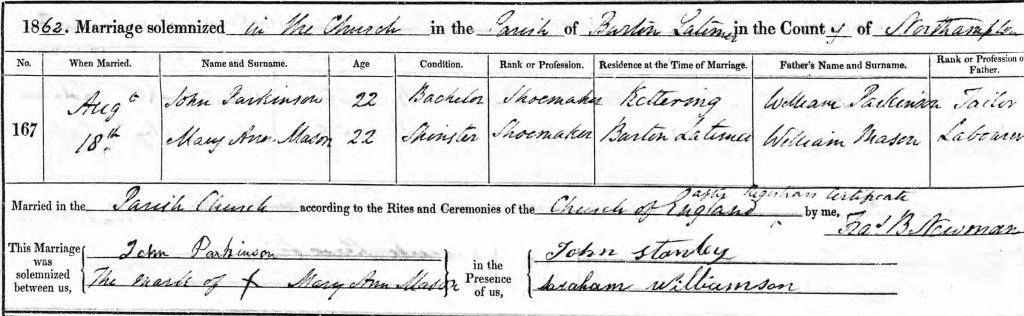
By the time of the 1871 census, John and Mary Ann are living at #5 Green Lane Terrace, Kettering, where they will live for the next 45 years. Mary Ann is no longer working outside of the home as she is taking care of Harry (age 8), Lizzie (age 6) and Tom (age 4). The day of the census, Mary’s youngest sister Ellen Mason (age 17 shoe fitter) is also at the house on Green Lane Terrace.

The 1881 census shows John (40) and Harry (age 18) as shoe finishers, Lizzie (16) is a shoe fitter, Tom (14) shoe finishers assistant. Mary Ann (40) and John have two more daughters, Nellie who is 9 and Rose who is 5.

John, at age 50, lists himself as the employer and a shoe manufacturer on the 1891 census. Mary Ann is also age 50. Lizzie (26) is a shoe fitter, Nellie (19) and Rose (14) are shoe machinist’s and there is another daughter Annie who is 8. There is also a 6 month old grandson named Fred Parkinson at the house on Green Lane Terrace. However, there is no record of who are his parents and the next Fred Parkinson is not born until 1907. Interestingly, I can not find a record of John and Mary Ann’s son Thomas and his wife Emily during the 1891 census. Is it possible that they lost their first son and re-used the name at a later time?
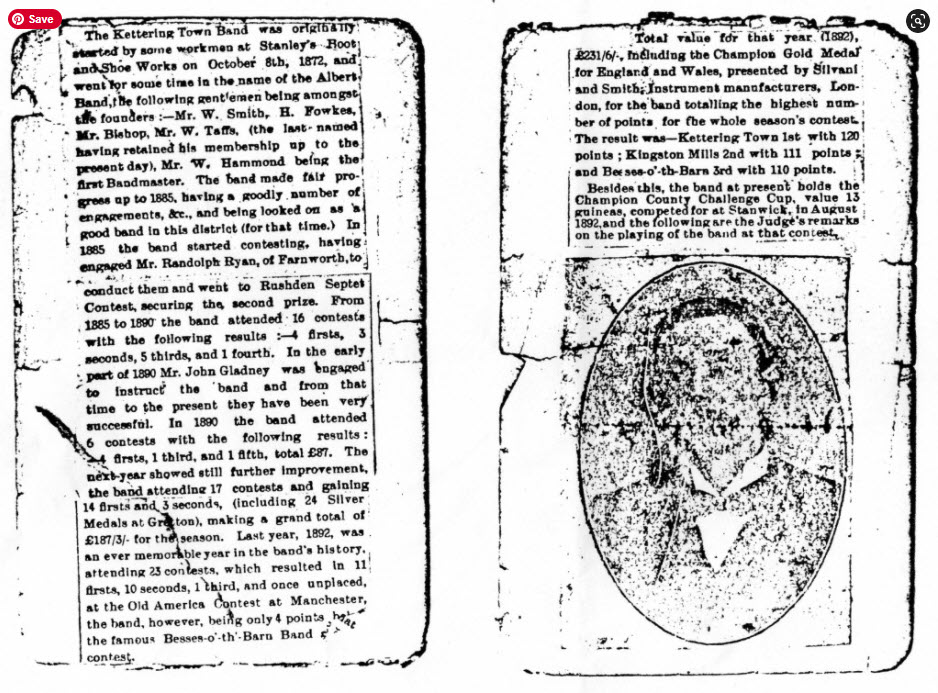
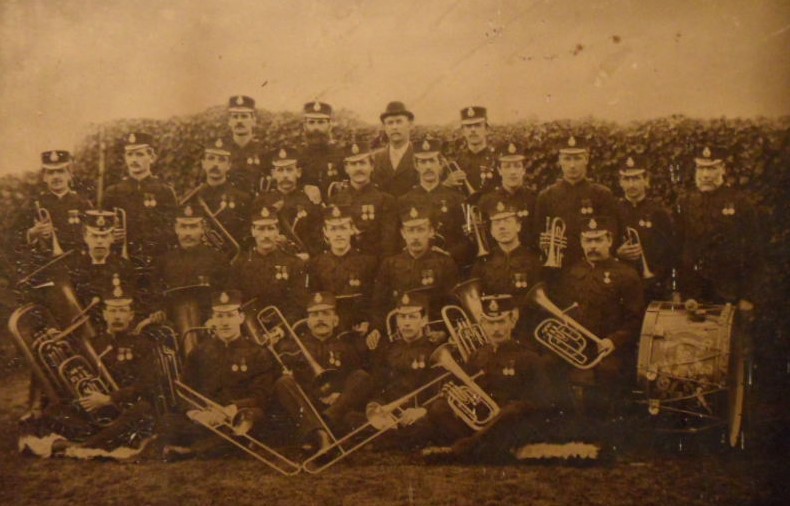
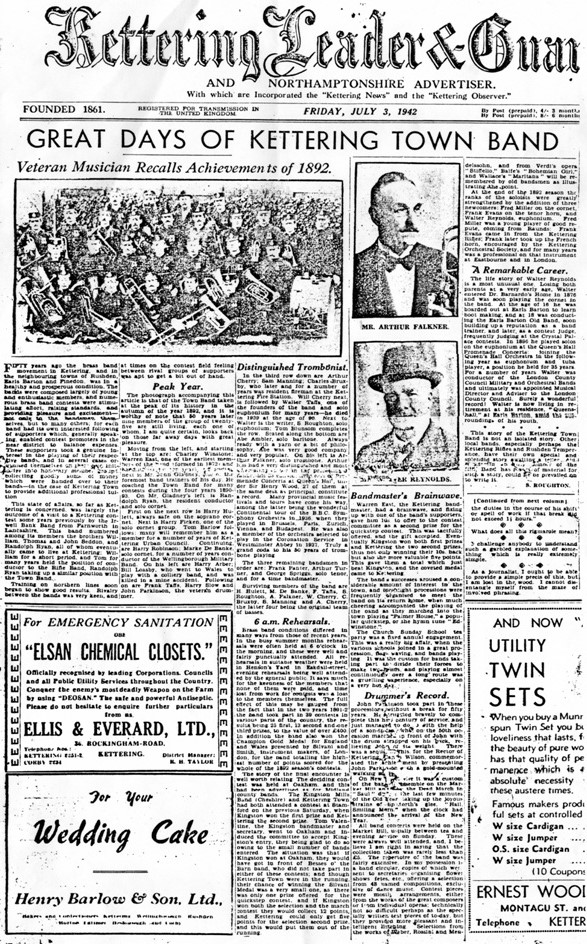
In 1892, the Kettering Town Band had the most memorable year in the band’s history, attending 23 contests, which resulted in 11 firsts, 10 seconds, 1 third, and once unplaced, at the Old America Contest at Manchester, the band, however, being only 4 points below the famous Besses o’ th’ Barn Band at that contest. Total value for that year (1892), £231 6s, including the Champion Gold Medal for England and Wales, presented by Silvani and Smith, Instrument manufacturers, London, for the band totaling the highest number of points for the whole season’s contest. John Parkinson was the drummer. Photograph is at the top of this blog post.
At age 60, John now has a job as a cleaner in the shoe factory. Mary Ann is also age 60 and listed on the 1901 census. Lizzie, now 36, is a shoe fitter and Annie, now 18, is a shoe machinist.
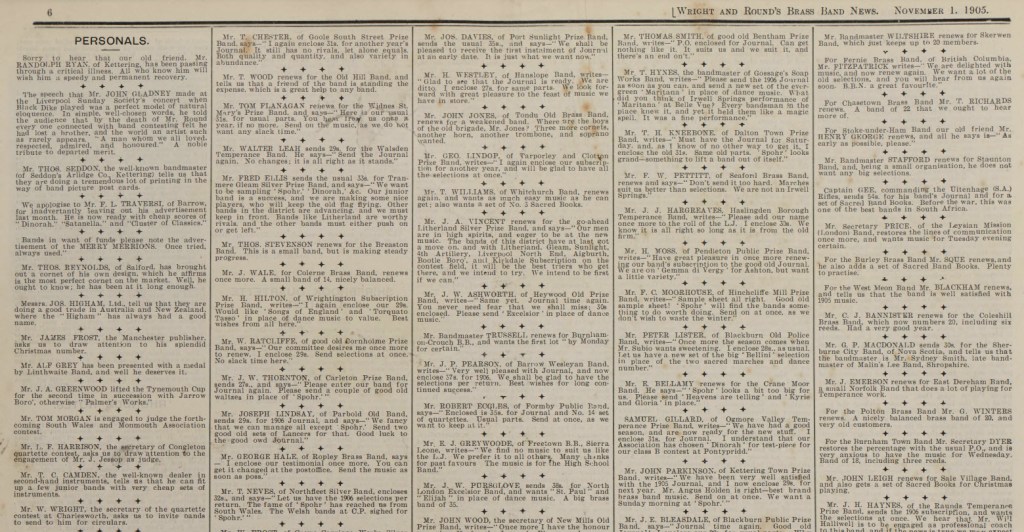
The 1911 census shows that John (now 70) and Mary Ann (now 69) are by themselves at #5 Green Lane. John lists himself as a retired shoe finisher. The census shows that they had 6 children and 4 are still living. Harry died in 1906 and Lizzie in 1909. This is also the year that John received a gold encrusted watch for completing 50 years as a drummer in the Town Band.
Mr. and Mrs. Parkinson celebrated their Golden Wedding on 12th August 1912.
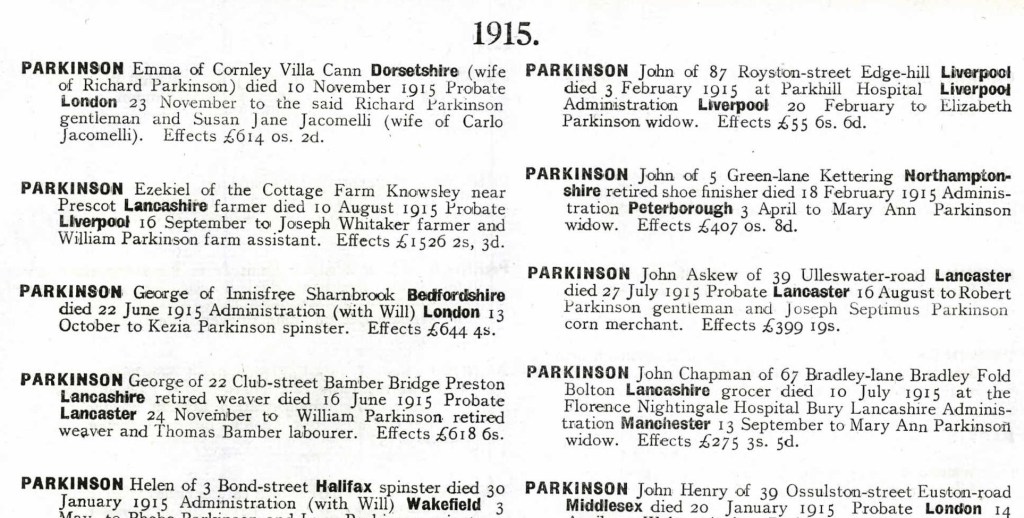
John Parkinson died on February 18, 1915.
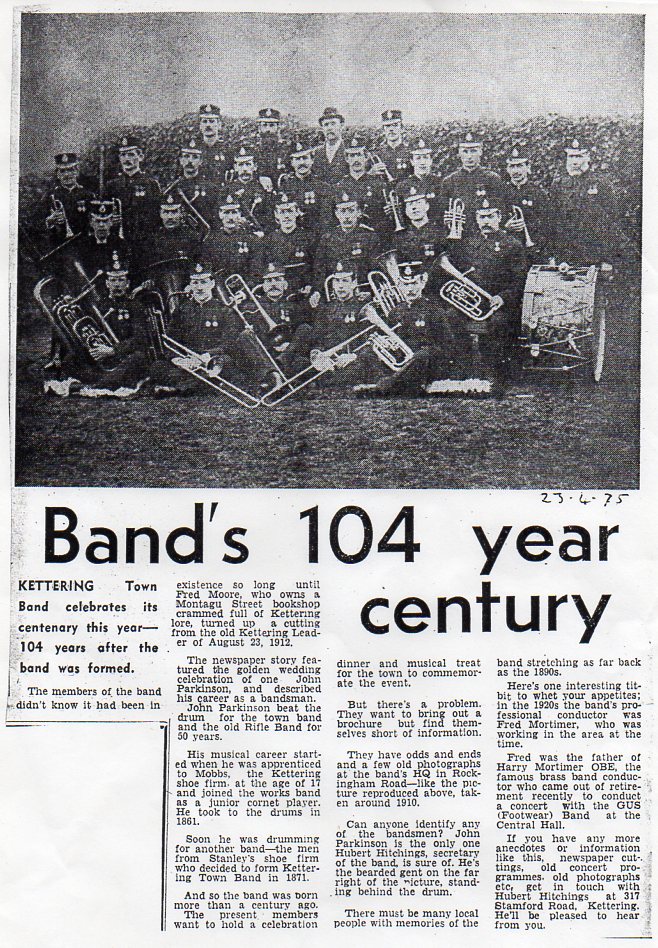
In 1975, the Kettering Town Band celebrated it’s centenary year, 104 years after the band was formed. The members of the band didn’t know it had been in existence so long until Fred Moore, who owns a Montagu Street bookshop crammed full of Kettering lore, turned up a cutting from the old Kettering Leader of August 23, 1912.
The newspaper story featured the golden wedding celebration of one John Parkinson and described his career as a bandsman.
John Parkinson beat the drum for the town band and the old Rifle band for 50 years.
His musical career started when he was apprenticed to Mobbs, the Kettering shoe firm at the age of 17 and joined the works band as a junior cornet player. He took to the drums in 1861.
Soon he was drumming for another band – the men from Stanley’s shoe firm who decided to form Kettering Town Band in 1871.
And so, the band was born more than a century ago.
 Chance Objects